Showing posts with label Phyllanthaceae. Show all posts

Sunday, 4 May 2014

Phyllanthus acidus - Cermai

Cermai is the fruit of Phyllanthus acidus, also known as Malay gooseberry, is an exotic local fruit of the tropical Asia.  

A cermai tree can grow up to 10 meter in height.  The leaves are ovate, alternates, light green in colour.  The flowers can be male, female or hermaphrodite, small and pinkish in clusters on the branches.  The fruits are pale yellow, waxy, crisp and juicy, with 4 – 6 seeds.


Cermai is cultivated mainly for its fruit, which is very sour, thus seldom consumed fresh.  The cermai fruit is mostly used in cooking, pickled in salt, sweetened and made into syrup.  It is also consumed raw mixed in rojak buah, or pounded with sambal belacan and eaten with rice.    The young leaves can also be eaten as greens 

Tuesday, 30 November 2010

Rare Fruits of MAHA 2010


Averrhoa bilimbi – Belimbing Buluh
Family : Oxalidaceae
Origin : Moluccas
Uses : eaten fresh ; condiment ; pickled


Carissa carandas – Asam Renda, Kerenda, Kalakai
Family : Apocynaceae
Origin : India
Uses : pickles ; folk medicine for anaemia.


Cynometra cauliflora – Namu-namu, Buah Katak Puru
Family : Fabaceae
Origin : Malesia
Uses : eaten fresh


Diospyros digyna – Black Sapote
Family : Ebenaceae
Origin : Central America
Uses : eaten fresh ; unripe fruit as fish poison.


Diospyros discolour – Buah Mentega
Family : Ebenaceae
Origin : Philippines
Uses : n.a.


Ficus ariculata - Ara
Family : Moraceae
Origin : India
Uses : eaten fresh ; dried. 

Flacourtia jangomas – Rukam Manis
Family : Salicaceae
Origin : India
Uses : eaten fresh ; jam ; folk medicine.

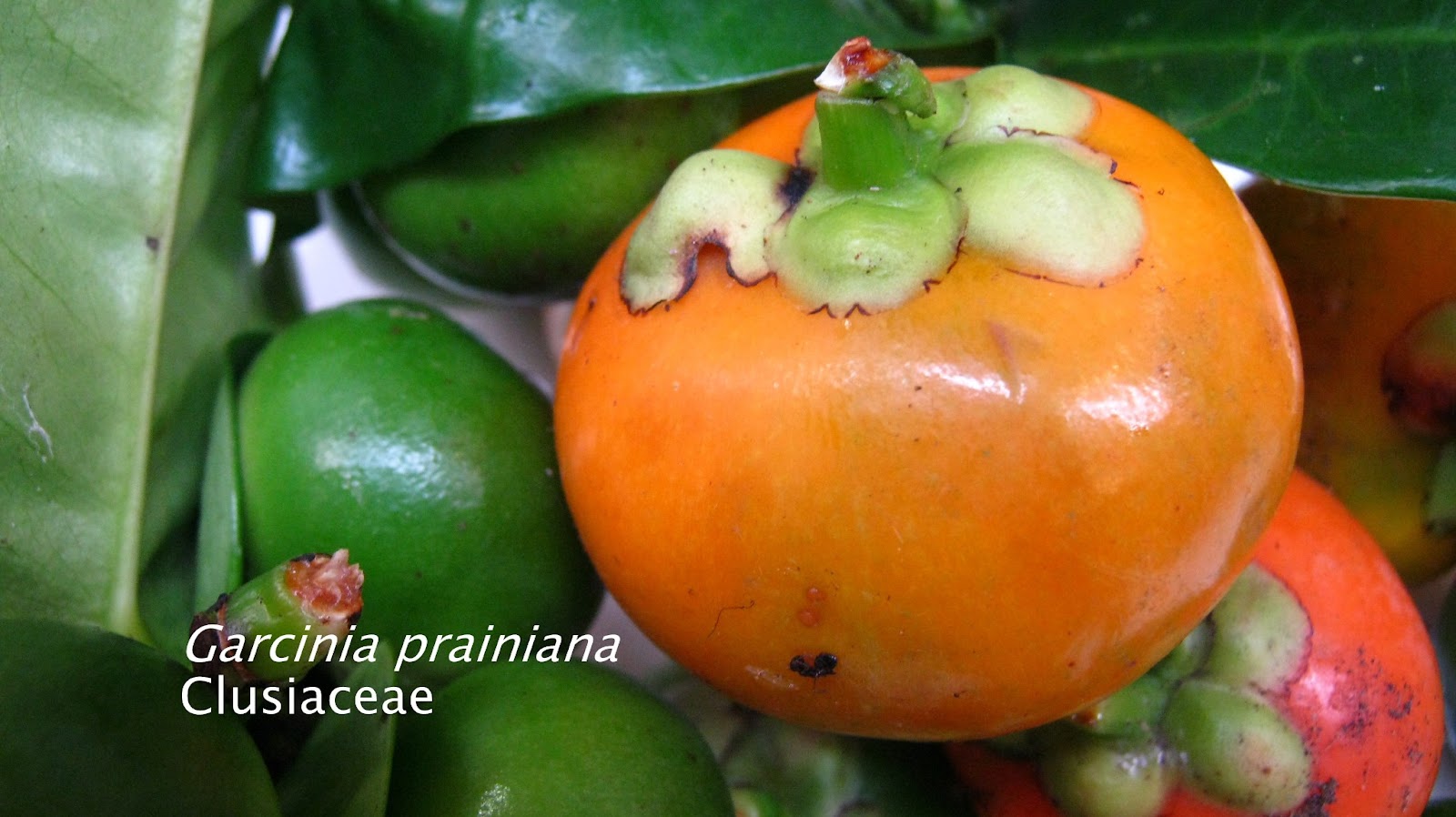
Garcinia prainiana – Cherapu
Family : Clusiaceae
Origin : n.a.
Uses : eaten fresh


Garcinia atrroviridis – Asam Gelugur
Family : Clusiaceae
Origin : Malesia
Uses : spice


Inga edulis – Ice-Cream Bean
Family : Fabaceae
Origin : South America
Uses : n.a.


Myristica fragrans – Buah Pala, Nutmeg
Family : Myristicaceae
Origin : Moluccas
Uses : Spice ; Juiced ; Dried.


Phyllanthus emblica  - Buah Melaka, Indian Gooseberry, Aamla
Family : Phyllanthaceae
Origin : n.a.
Uses : Eaten fresh ; cooked ; pickled ; folk medicine


Pouteria caimito – Abiu
Family : Sapotaceae
Origin : South America
Uses : eaten fresh ; folk medicine for cough, fever, diarrhea, bronchitis etc


Pouteria campechiana  - Canistel
Family : Sapotaceae
Origin : Central America
Uses : eaten fresh.


Rollinia deliciosa - Biriba
Family :  Annonaceae
Origin : South America
Uses : eaten fresh


Friday, 30 April 2010

Sauropus androgynus - Cekur Manis

Synonyms : S. albicans, S. sumatranus, Clutia androgyna.

.

Order : Magnoliopsida

Family : Phyllanthaceae

Tribe : Phyllantheae

Surtribe : Flueggeinae

.

The genus Sauropus comprises about 40 species.

.

Commonly known as star gooseberry, sweet leave, cekur manis (Malay), katuk (Indonesia), Pak wanban (Thai), rau ngót (Vietnamese), 树仔菜, 板面菜 and 马尼菜.

.

It’s a perennial herb capable to reach 3 m in height. Stems are multiple, semi-woody, upright, green in colour, about 0.5 cm in diameter. Older stem may become somewhat woody and have slight brownish colour. Leaves are pinnately altenate, ovate. The mature leaves dark green with 5 – 6 cm long, younger shoots tends to be lighter green. Flowers underside of leaves’ petiole, small, 0.5 mm diameter, white to pinkish. Fruits are capsules, white to reddish, with 3 black seeds.


Propagation is by cuttings. Easily propagated and heavy yielding.

.

The leaves and shoots are consumed as leafy vegetable.

.

Studies shows that the leaf contains 88.32% water, 4.84% protein, 0.19% lipid, 5.36% carbohydrate, and 1.11 fiber 2. The leaf also contains b-carotene, vitamin C, calcium, potassium, iron and magnesium. It’s among only a few floral containing vitamin K.

.

However, studies have suggested that its consumption can cause lung damage, due to its high concentration of papaverine ( 580mg/100g fresh leaf 1).

.
.
.
..
.
.

1.P.Padmavathi & M.Prabhakara Rao, 1990, Nutritive Value of Sauropus androgynus Leaves, Plant Food for Human Nutrition 40:107-113.

2. Naruman Benjapak et al, 2008, Determination of Antioxidant Capacity and Nutritive Values of Pak-Wanban, KKU Sci. J. 36(4) 279-289 (2008)


Thursday, 8 April 2010

Baccaurea

Baccaurea of family Phyllanthaceae, is a genus of small, dioecious trees. The flowers are borned in clustered spikes. The fruit is a drupe, has a firm, fleshy pericarp, with 1 – 6 large seeds, with juicy sourly endocarp. Several species are edible, and some are cultivated.

There are some 80 species of Baccaurea genus, distributed naturally from India to SE.asia.


Baccaurea angulata- red angle tampoi .


Baccaurea motlyena - rambai


Baccaurea macrocarpa – tampoi