Showing posts with label Arecaceae. Show all posts

Sunday, 25 January 2015

Royal Family of Palms

Royal Palm
Scientific name : Roystonea regia

Synonyms : Euterpe ventricosa, Euterpe jenmanii , Oreodoxa regia, Oenocarpus regius, Palma elata , R. floridana, R. jenmanii, R. elata, R. ventricosa, R. regia var. hondurensis

Common names : Cuban royal palm, Florida royal palm, Royal palm

Native : Southern Florida, Mexico, Central America, and the Caribbean


Caribbean Royal Palm
Scientific name : Roystonea olearcea

Synonyms : Areca oleracea, Euterpe caribaea, Gorgasia oleracea,  Kentia oleracea , Oreodoxa oleracea, Oreodoxa caribaea, R. caribaea, Oreodoxa regia var. jenmanii, R. oleracea var. excelsior, R. venezuelana, R. oleracea var. jenmanii

Common names : palmiste, imperial palm, cabbage palm

Native : Lesser Antilles, Columbia, Venezuela, Trinidad and Tobago.

Dwarf Royal Palm
Scientific name : Adonidia merrillii

Synonyms : Normanbya merrillii, Veitchia merrillii

Common names : Manila palm, Christmas palm

Native : The Philippines, Sabah 

Pinang Rajah
Scientific name : Cyrtostachys renda

Synonyms : Areca erythrocarpa, A. erythropoda, Cyrtostachys lakka, C. rendah, C. lacca var singaporensis, C. lakka, Pinanga purpurea, Ptychosperma coccinea

Common names : Pinang rajah, red palm, red sealing wax palm, lipstick palm

Native : Thailand, Malaya, Sumatra, Borneo


King Palm
Scientific name : Archontophoenix alexandrae

Synonyms :  Cocos romanzofiana, C. australis, C. plumose, C. datil, C. geriba, C. arechavaletana, Calappa acrocomioides, Calappa australis, Calappa datil, Calappa plumose, Calappa romanzoffiana.

Common names : Alexander palm, King palm

Native : Queensland & NSW


Queen Palm
Scientific name : Syagrus romanzoffiana

Synonyms : Ptychosperma alexandrae

Common names : Queen palm, Cocos plam

Native : Paraguay, Argentina, Brazil, Bolivia


Princess Palm
Scientific name : Dicyosperma album

Synonyms : Areca alba, A. borbonica, A. lacteal, A. propria, A. purpurea, A. furfuracea, A. rubra, A. pisifera, A. aurea, Dictyosperma aureum, D. furfuraceum, D. rubrum, Linoma alba, Sublimia palmicaulis.

Common names : Princess palm, hurricane palm

Native : Mascarene Islands

Wednesday, 8 February 2012

Sarikei : Local Vegetables


pineapple shoots
Ananas comosus

bamboo shoots, rebong, tubu manis, embong
Bambusa sp

shoots of emparuk
Limnocharis flava


shoots of keladi
Calocasia esculenta

kernel of kepayang
Pangium edule


Thursday, 2 June 2011

National & State Flowers of Malaysia


National flower

Malaysia Hibiscus rosa-sinensis ( Bunga raya )


In Malaysian coat of arm, a betel nut palm ( Areca catechu ), a Melaka tree ( Phyllanthus emblica ), and a hibisus flower ( Hibiscus rosa-sinensis ) are despited on the sheild, which represents states of Pulau Pinang and Melaka.  The section with hibiscus flower in the lower-middle supposely represented Singapore.


State flowers

Johor – n.a.
There is no state flower assigned to the state of Johor. 

However, in Johor’s coat of arms, the mirrored flora represents gambir ( Uncaria gambir ) and black pepper ( piper nigrum ), once an important crops cultivated in Johor.


Kedah – n.a.
There is no state flower assigned to the state of Kedah.  

The wreath in the Kedah’s coat of arms, is depicted as two stalks of rice ( Oryza sativa ) together, and enveloping the shield and crescent.  It represents rice as the state principal product.


Kelantan – n.a.
There is no state flower assigned to the state of Kelantan. 


Melaka - Vallabris Glabra ( kesidang )
In Melaka’s coat of arms, a Melaka tree ( Phyllanthus emblica ) is depicted in the middle of the shield, of which the state derives its name.  It is also under the Melaka tree of which Parameswara rested, and decided to found the kingdom of Melaka.


Negeri Sembilan – n.a.
There is no state flower assigned to state of Negeri Sembilan.  

In Negeri Sembilan’s coat of arms, nine stalk of rice ( Oryza sativa ) s depicted in the middle of the shield.  The nine stalks signifies the nine states under the old Negeri Sembilan.


Pahang – n.a
There is not state flower assigned to the state of Pahang.


Perak – n.a.
There is no state flower assigned to the state of Perak.  

The coat of arms of Perak is circled with a crescent that contains flowers of rice ( Oryza sativa ) of which the flowers of rice reflects the source of income for Perak.

Perak Tourist Association is proposing Kinta weed orchid ( Vanda hookeriana ) as Perak’s state flower. 


Perlis – n.a.
There is no state flower assigned to the state of Perlis.  

In Perlis' coat of arms, a wreath is depicted surrounding the shield.  The wreath illustrated as a pair of green untied rice stalks ( Oryza sativa ) that nearly envelope the shield.  The wreath signifies the cultivation of rice as the state’s main product and a major source of its economic activities.  The yellow wreath within the arm’s shield carry the same symbolization.


Pulau Pinang – n.a.
There is no state flower assigned to the state of Pulau Pinang.  

At the top of Pulau Pinang's coat of arms is a betel nut palm ( Areca catechu ) of which the state derives its name.


SabahRaffessia sp ( Rafflesia )

Sarawak Phalaenopsis bellina ( synonym Phalaenopsis violocea )( Normah orchid )

In Sarawak's state coat-of-arm, it appears that there are 2 Hibiscus flower attached to both left and right side of a Rhinoceros hornbill, the official state bird.

Eusideroxylon zwaggen, of which the timber are harvested for its Belian wood, is the official state tree.

Semah fish ( Tor douronensis ), nicknamed 'swimming goldmine' is the official state fish.


Selangor Mimusop elengi ( bunga tanjung )

TerengganuAllamanda cathartica ( alamanda )

Friday, 13 May 2011

Nypa fruticans - Nipah

Nypa fruticans, known ask the nipah palm, or attap palm.  It is the only palm species considered a mangrove in the Mangrove Biome.  N. fruticans is a monotypic taxon, meaning that it’s a lone biological type within the genus.

N. fruticans grows in soft mud of southern Asian and northern Australia costal tropical.  It is an endangered species in Singapore.

It has a horizontal trunk that grows beneath the ground, only the leaves and flower stalk grow upwards above the surface.   The leave frond can reach up to 10 meter in height.  The flowers are a globular inflorescence of female flowers at the tip, with yellow-to-red male flowers on the lower branches.    The fruit is a drupe, fibrous, airy, in a cluster.  Ripe fruitlets separated from the bunches, and floated away on the tide.

Nypa fruticans is a very useful plant.
The piths ( umbut ) are harvested, consumed as vegetables.  The long, feathery frond are used as roofing material ( daun attap ), and wall panel.
The leaflets are used in basketry.  Young leaflets are used to wrap tobacco for smoking.


The flower cluster can be tapped before blooming, to yield a sweet edible sap ( nira nipah ), collected to produce alcoholic drink, vinegar, and palm sugar ( gula apong )

Seeds of young fruits ( attap-zi ) are sweet, translucent, gelatinous, used as a dessert ingredient ( air batu campur ) or fruit cocktail.
Seeds of older fruit are made into powder.

Nypa sap produces 6,480-15,600 liters of ethanol per hectare per year, compare to sugarcane 5,000-8,000 liter/ha/year, and corn just only 2,000 liter/ha/year.
 

Thursday, 28 April 2011

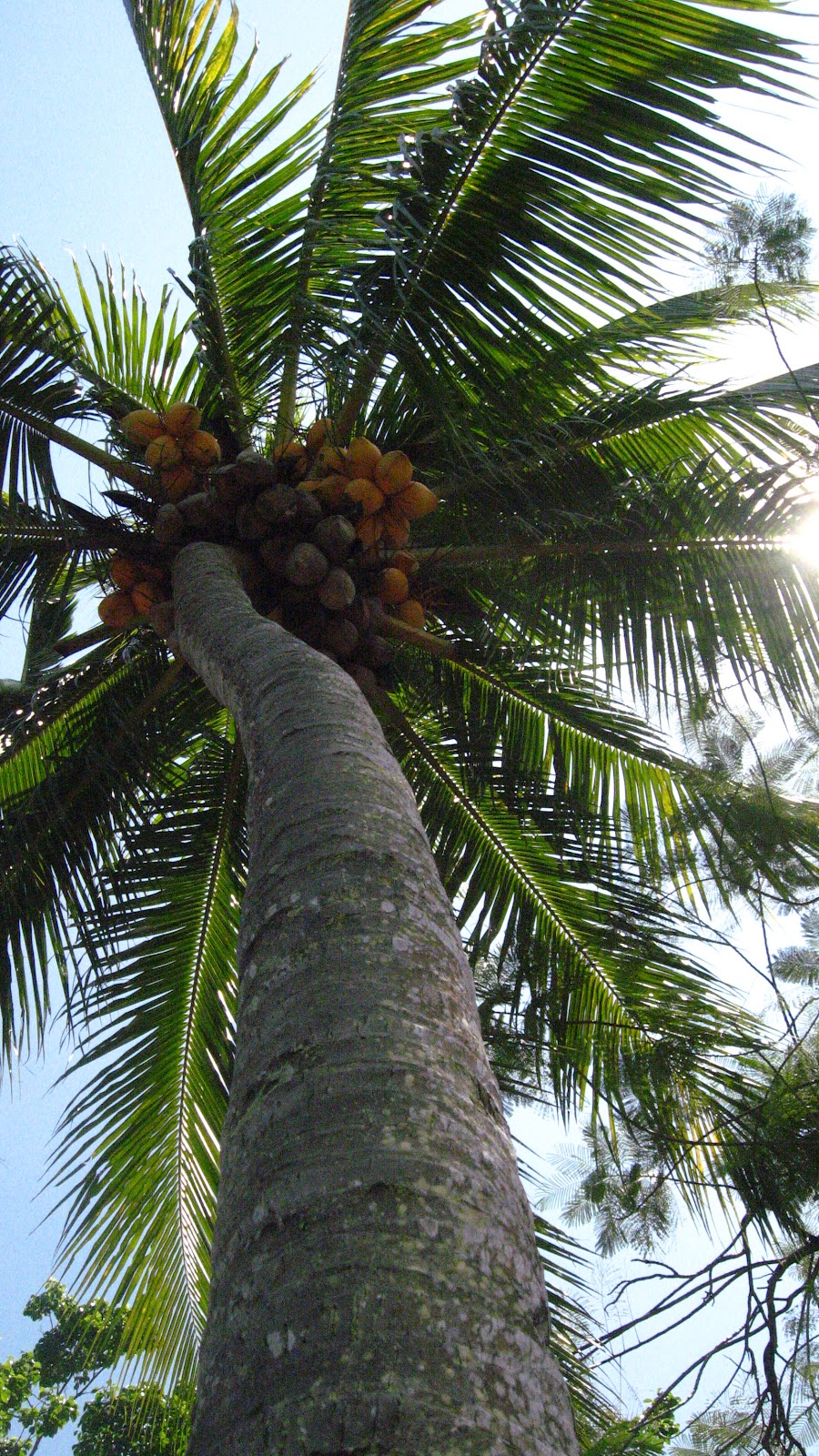
Cocos nucifera - Coconut

Coconut , Cocos nucifera is a member of the family Arecaceae ( Palmae – palm family ).  It is the only accepted species in the genus Cocos.    The term coconut can refer to the entire coconut palm, the seed, or the fruit.

Found across most part of the tropics, coconut is known for its great versatility in the many uses of its different parts.  
Its endosperm is know as the edible ‘meat’ of the fruit, when dried, it is called copra ; 
the oil and milk derived from the ‘meat’ are commonly used in cooking and frying ; 
coconut oil can made into soaps and cosmetics ; 
coconut water is a refreshing drink, and can be processed into alcoholic drink ; 
the sap derived from incising the flower cluster can be processed into palm sugar, and alcoholic drink ; 
apical buds of adult palm, known as ‘heart of palm’ are harvested for consumption, are a rare delicacy ; 
the husks can be processed into fiber for use in ropes, mats, brushes sacks, mattresses, mulching, and building material ; 
fresh leaves are weaved into shell as a container to fill rice and cooked to make ketupat
dried leaves can be made into brooms, roofing ; 
husks and shells can be used for fuel and made into charcoal ; 
trunk are used for house construction, building small bridge ; etc

Botanically, the coconut fruit is a drupe, not a true nut.  Like other fruits, it has 3 layers ; exocarp ( skin ) , mesocarp ( husk ), and endocarp ( hard shell containing endsperm )


Thursday, 17 February 2011

Hearts of Palms

Umbut is the Malay word for heart-of-palm, which is a vegetable harvested from the inner core and growing bud of certain palm trees.  It is costly because harvesting in the wild kills the tree.  It is therefore sometimes called the  ‘millionaire’s salad’.

A wide variety of palms are harvested for their heart, notably coconut ( Cocos nucifera ), Palmito Juçara ( Euterpe edulis ), Açaí palm ( Euterpe oleracea ), sabal ( Sabal spp ), pejibaye ( Bactris gasipaes ), oil palm ( Elaeis guinensis ) …

A stroll down the Sarikei’s Sunday market at Jalan Nyelong, one will be amazed with the variety of palm’s heart on sale…


This is sago's heart.  Metroxylon sagu also processed into sago pearl.


Mother said this is of nipah's, ( Nypa fruticans ),
which fruits are also harvested for its translucent, sweet kernel called atapzi in Hokkien. 
Sap collected from its inflorecence is made into alcoholic drink, vineger or atap sugar.
Young leaves are used for wraping tabacco for smoking.


This is umbut upeng, as the Iban lady said. 
Arenga sp. ?


This is hearts of Oncosperma tigillarium, a thorny palm.


This is supposedly rattan's shoots, locally known as selaris, laris, or moa.
Plectocomiopsis geminiflora 


Last, but not least, coconut's ...
Cocos nucifera