Showing posts with label Cocos nucifera - coconut / kelapa. Show all posts

Thursday, 28 April 2011

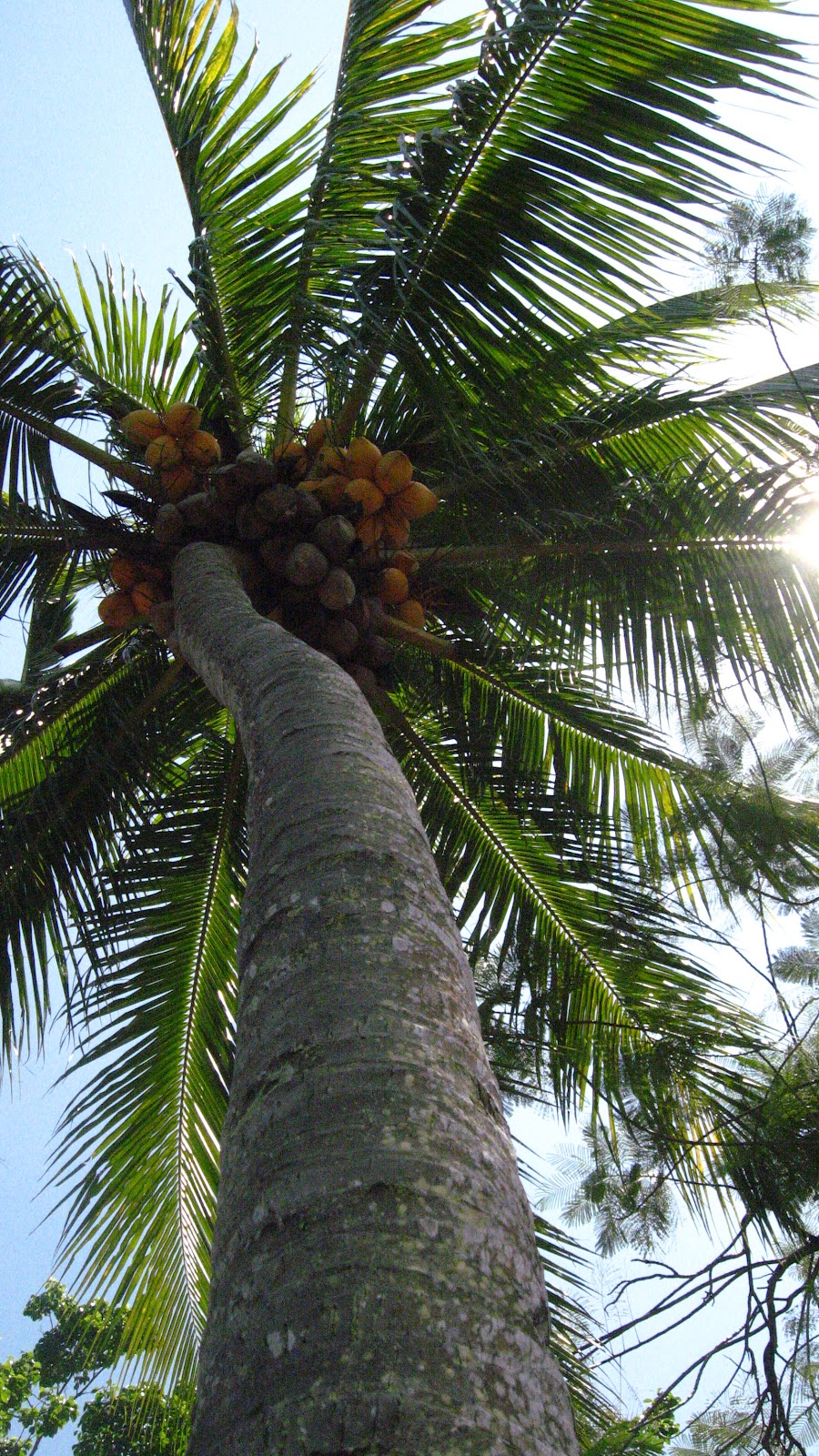
Cocos nucifera - Coconut

Coconut , Cocos nucifera is a member of the family Arecaceae ( Palmae – palm family ).  It is the only accepted species in the genus Cocos.    The term coconut can refer to the entire coconut palm, the seed, or the fruit.

Found across most part of the tropics, coconut is known for its great versatility in the many uses of its different parts.  
Its endosperm is know as the edible ‘meat’ of the fruit, when dried, it is called copra ; 
the oil and milk derived from the ‘meat’ are commonly used in cooking and frying ; 
coconut oil can made into soaps and cosmetics ; 
coconut water is a refreshing drink, and can be processed into alcoholic drink ; 
the sap derived from incising the flower cluster can be processed into palm sugar, and alcoholic drink ; 
apical buds of adult palm, known as ‘heart of palm’ are harvested for consumption, are a rare delicacy ; 
the husks can be processed into fiber for use in ropes, mats, brushes sacks, mattresses, mulching, and building material ; 
fresh leaves are weaved into shell as a container to fill rice and cooked to make ketupat
dried leaves can be made into brooms, roofing ; 
husks and shells can be used for fuel and made into charcoal ; 
trunk are used for house construction, building small bridge ; etc

Botanically, the coconut fruit is a drupe, not a true nut.  Like other fruits, it has 3 layers ; exocarp ( skin ) , mesocarp ( husk ), and endocarp ( hard shell containing endsperm )


Thursday, 17 February 2011

Hearts of Palms

Umbut is the Malay word for heart-of-palm, which is a vegetable harvested from the inner core and growing bud of certain palm trees.  It is costly because harvesting in the wild kills the tree.  It is therefore sometimes called the  ‘millionaire’s salad’.

A wide variety of palms are harvested for their heart, notably coconut ( Cocos nucifera ), Palmito Juçara ( Euterpe edulis ), Açaí palm ( Euterpe oleracea ), sabal ( Sabal spp ), pejibaye ( Bactris gasipaes ), oil palm ( Elaeis guinensis ) …

A stroll down the Sarikei’s Sunday market at Jalan Nyelong, one will be amazed with the variety of palm’s heart on sale…


This is sago's heart.  Metroxylon sagu also processed into sago pearl.


Mother said this is of nipah's, ( Nypa fruticans ),
which fruits are also harvested for its translucent, sweet kernel called atapzi in Hokkien. 
Sap collected from its inflorecence is made into alcoholic drink, vineger or atap sugar.
Young leaves are used for wraping tabacco for smoking.


This is umbut upeng, as the Iban lady said. 
Arenga sp. ?


This is hearts of Oncosperma tigillarium, a thorny palm.


This is supposedly rattan's shoots, locally known as selaris, laris, or moa.
Plectocomiopsis geminiflora 


Last, but not least, coconut's ...
Cocos nucifera


Friday, 2 July 2010

Nature Fiber - Coir 椰壳纤维


Coir is extracted from the tissues surrounding the seed of the coconut palm ( Cocos nucifera ). There are two types of coir : brown fiber, which is obtained from mature coconuts ; and white fiber, which is extracted from immature green coconuts after soaking for up to 10 months.

White coir spun into yarn is used in the manufacture of rope and fishing nets. Brown coir is used in sacking, brushes, doormats, rugs, mattresses, insulation panels and packaging. In Europe, the automobile industry upholsters cars with pads of brown coir bonded with rubber latex.

Geotextiles made from coir mesh are durable, absorb water, resist sunlight, facilitate seed germination and are 100% biodegradable.


Coir peat, a residue of milling, is gaining importance as mulch, soil treatment and a hydroponic growth medium.


Globally, about 500,000 tonnes of coir are produced annually, mainly in India and Sri Lanka, followed by Thailand, Vietnam, the Philippines, and Indonesia.
.
.
.
.

.
.
.
.
.


http://www.naturalfibres2009.org

Thursday, 18 March 2010

Thailand : in a glimpse - fruits


.

.
..
.
.
.
Cocos nucifera
Common name : Coconut, Kelapa (Malay), , ma phrao-มะพร้าว(Thai)
Family : Asteraceae
.
.
.


.


.
Areca catechu
Common name : Betel Nut, 槟榔, Pinang (Malay), mak-หมาก (Thai)
Family : Asteraceae
.
Annona muricata
Common name : Soursop, durian belanda (Malay), 红毛榴莲, ทุเรียนเทศ (Thai)
Family : Annonaceae
.
Pyrus sp
Common name : Pear, 梨子
Family : Rosaceae
.
Manilkara zapota
Common name : Sapodilla, Ciku (Malay), 人心果, lamoot-ละมุด (Thai)
Family : Sapotaceae
.
Psidium guajava
Common name : Guava, Jambu batu (Malay), 番石榴, fa rang-ฝรั่ง (Thai)
Family : Myrtaceae
.
Syzygium malaccense
Synonyms : Caryophyllus malaccensis, Eugenia malaccensis
Common name : Malay Rose Apple, Jambu Bol (Malay), ชมพู่มะเหมี่ยว (Thai)
Family : Myrtaceae
.

Bouea macrophylla
Common name : Kundang (Malay), มะปราง (Thai)
Family : Anacardiaceae
.
Mangifera indica Chauk anan
Common name : Mango, Mangga(Malay), 杧果,ma muaang-มะม่วง (Thai)
Family : Anacardiaceae
.

Leucaena leucocephala
Common name : Petai Hutan (Malay ), Krathin- กระถิน (Thai)
Family : Fabaceae
.

Arachis hypogaea
Common name : Peanut, Kacang Tanah (Malay), 花生,thuaa li sohng- ถั่วลิสง (Thai)
Family : Fabaceae
.

Tamarindus indica
Common name : Tamarind, Asam Jawa (Malay), ma khaam- มะขาม (Thai)
Family : Fabaceae
.
Hibiscus sabdariffa
Common name : Roselle, 洛神花, krajeab-กระเจี๊ยบ (Thai)
Family : Malavaceae
.
Citrullus lanatus
Common name : Watermelon, 西瓜, Tembikai (Malay), taengmo-แตงโม (Thai)
Family : Cucurbitaceae
.

Tricosanthes dioca
Common name :  timun potol (Malay)
Family : Cucurbitaceae
.
Piper betle
Common name : Betel, 蒌叶, Sireh (Malay), พลู (Thai)
Family : Piperaceae
.

Capsicum frutescens
Common name : Thai pepper, 小米椒,Chili Api (Malay), พริกขี้หนู (Thai)
Family : Solanaceae

.

??
Common name : orange, som- ส้ม (Thai)
Family : Rutaceae
.

???

.

???