Showing posts with label allelopathy. Show all posts

Sunday, 19 November 2017

Wayside Alien Fabaceae ( Mimosoideae ) @ Seremban2

Leucaena leucocephala ( petai belalang ) has been described as a ‘miracle tree’ for its multiple uses, yet also dubbed as a ‘conflict tree’ as a noxious weed.

Described as the world’s most widely used forage tree legume by FAO, L. leucocephala in an excellent source of high-protein fodder for animal feed and excellent firewood, and efficient in nitrogen fixation.  The young shoots, young pods, and mature seeds are consumed as food for human.  However, it contains mimosine, a toxic amino acid to non-ruminant vertebrates.

Yet, it is listed as one of the 100 worst invasive alien species by IUCN Invasive Species Specialist Group.  It can grow wide range of soil and rainfall environment, grows quickly and forms dense thickets and produces large quantity of seeds.

Key words : allelopathic, N-fixation, mimosine. 
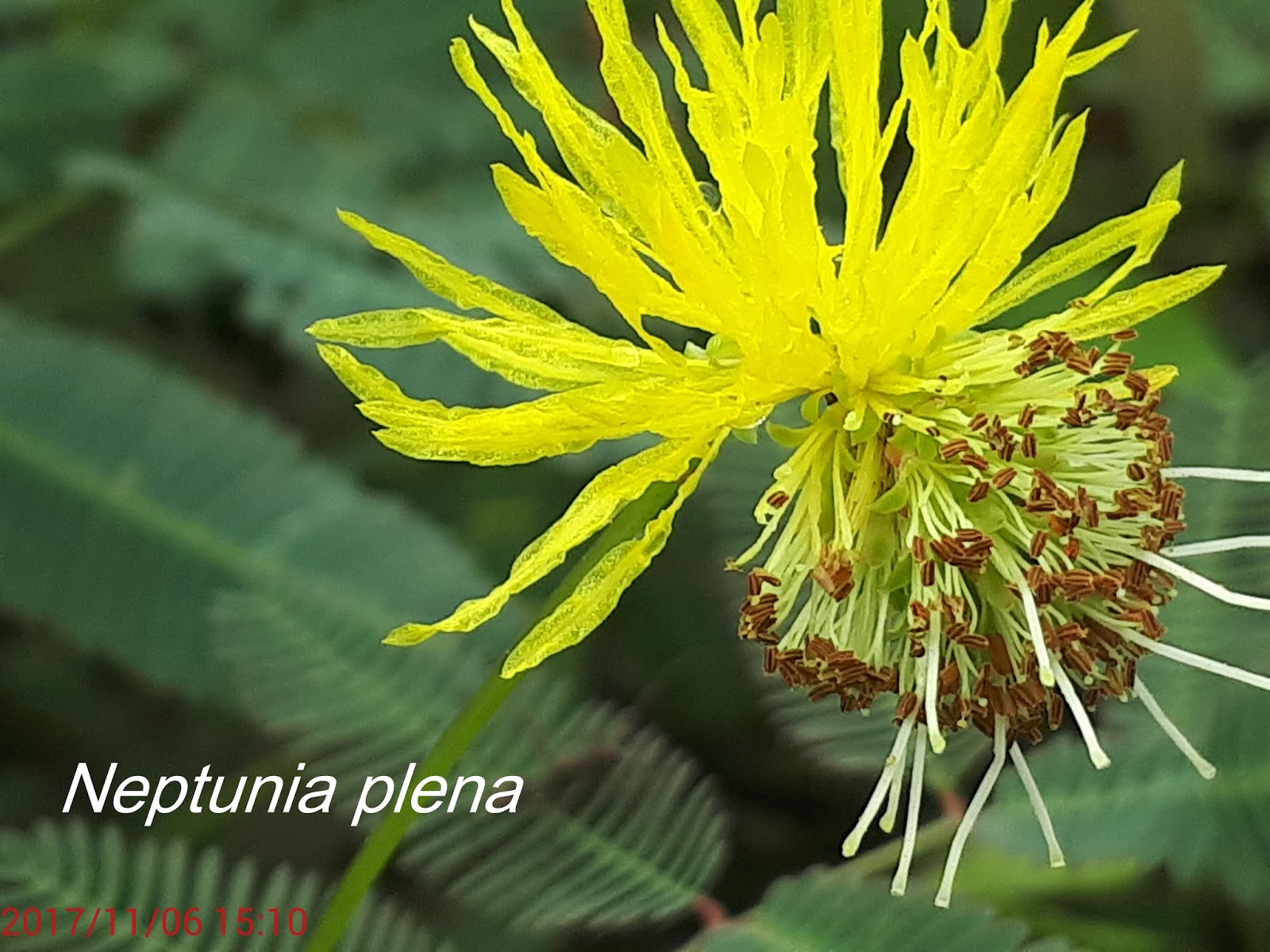


Neptunia plena ( aquatic sensitive plant ) is an invasive plant thriving on waterlogged area and watercourses.  It is not confined to wetlands but tolerates considerable flooding.  During dry period, the plants become dormant and persist as seeds.  It can lead to increased algal blooms reduce water quality by preventing light penetration and reduce oxygenation of water. 

N. plena and N. oleracea are both referred as ‘water mimosa’.  Water mimosa is a restricted invasive plant under Queensland’s Biosecurity Act 2014.

Key words : allelopathic, N-fixation, mimosine. thigmonasty


Mimosa pudica ( sensitive plant )  is most probably the well-known for its rapid plant movement.  It is most often grown as potted plants for its curiosity value.  It also became an ideal plant for experiments regarding plant habituation and memory.

M. pudica has been listed in the Global Invasive Species Databease 2010.

Key words : allelopathic, N-fixation, nyctinastic, mimosine. thigmonasty


Mimosa diplotricha ( giant sensitive plant ) includes 3 varieties : diplotricha, odibilis and inermis

Although M. diplotricha is an excellent ground cover and green manure, it is restricted invasive plant under Queensland’s Biosecurity Act 2014.

Key words : allelopathic, heliophytic, N-fixation, nyctinastic, mimosine. thigmonasty


Wednesday, 1 June 2016

Eucalyptus camaldulensis - River Red Gum

Eucalyptus camaldulensis is the river red gum, a tree of the Myrtaceae family.  It is native to Australia, where it naturally distributed along many inland water courses as well as floodplains.  Due to the proximity to watercourse, river red gum is subject to regulate flooding in its natural habitat.

The generic name ‘Eucalyptus’ is from the Greek words ‘eu’ good or well, and ‘kalyptos’ covered, referring to the calyx which forms a lid over the flowers when in bud.  Specific name “camaldulensis” referring to L’Hortus Camaldulensis di Napoli, from where the first specimen was first described by Frederick dehnhardt, in 1832.  The Camaldoli garden, which was established in 1816 by Francesco Ricciardi, Count Camaldoli, features collections of Acacia, Agavaceae, Melaleuca, Eucalyptus camaldulensis, and Quercus ilex.


River red gum is tolerant to waterlogging, as well as drought, salinity, fire and frost.  Globally, E. camaldulensis is widely planted in arid and semi-arid lands.

E. camaldulensis can grow up to 45 meters tall.  The tree has a large, dense crown.  The base of the bole can be covered with rough, reddish-brown bark.   The dull blue-green coloured leaves contain oil-producing glands in the un-veined areas. 


USES

Due to its fast-growing nature, it is cultivated for the wood.  Eucalyptus plantations are popular with honey producers, as they are safe and sheltered, and very few agro-chemicals are used.

River red gum wood is hard and dense (≈900kg/m3), but brittle, thus making hand working difficult.  It is used in rot resistant applications such as fence posts, sleepers, decks and wooden floors.  It is also popular firewood, the wood makes fine charcoal. 

E. camaldulensis is a natural biological drainage (biodrainage), often used to reclaim swampy sites.  The tree’s root can penetrate deep into the soil, capable to draw a tremendous amount of water from the ground, thus removing the water from the swamp.


HAZARDS

River red gum and many other Eucalypts was nicknamed, “widow maker”, as they tends to drop large branch without warning.  This form of self-pruning may be a means of saving water or simply a result of its brittle wood.

E. camaldulensis is known to exhibit allelopathic characteristic.  Several volatile and water-soluble toxins found in Eucalyptus tissues inhibit other plant species from growing nearby.  Accumulated Eucalyptus litters inhibit seeds germination, and stunted seedling growth.

Eucalypts draw a tremendous amount of water from the soil through the process of transpiration.  This may contribute to depletion of ground water and soil moisture.


Large amount of Eucalpytus litters, combine with the volatile oil produced by the leaves, lead to fire hazard in Eucalpytus plantation.  


Sunday, 28 September 2014

Allelopathy

Allelopathy is a biological phenomenon by which an organism produces one or more biochemicals that influence the growth, survival, and reproduction of other organisms. These biochemicals are known as allelochemicals and can have beneficial (positive allelopathy) or detrimental (negative allelopathy) effects on the target organisms.

Allelopathy is characteristic of certain plants, algae, bacteria, coral, and fungi.  Allelopathic interactions are an important factor in determining species distribution and abundance within plant communities, and are also thought to be important in the success of many invasive plants.


List of allelopathic plants

Shrubs
Adenostoma fasciculatum ( chamise )
Allaiaria petiolate ( garlic mustard )
Artemisia californica ( California sagebrush )
Asparatus officinalis ( asparagus )
Bassia scoparia ( burning bush )
Centaurea maculosa ( spotted knapweed )
Chromolaena odorata ( Siam weed )
Cyperus rotundus ( nut grass )
Encelia farinose ( brittlebush )
Forsythia spp
Helianthus annuus ( sunflower )
Lantana camara ( bunga tahi ayam )
Rhododendron spp
Salvia leucophylla ( purple sage )
Sambucus spp ( elderberry )
Solidago spp ( goldenrod )

Trees
Ailanthus altissima ( tree of heaven )
Arctostaphylos uva-ursi ( Manzanita )
Casaurina equistifolia ( rhu pantai )
Delonix regia ( red flame )
Eucalyptus spp
Juglans nigra ( black walnut )
Pinus spp ( pines )
Prunus laurocersus ( cherry laurel )

Crops
Avena spp ( oats )
Coffea Arabica ( coffee )
Hordeum vulgare ( barley )
Nicotina tabacum ( tabacco )
Oryza sativa ( rice )
Secale cereal ( rye )
Triticum aestivum ( wheat )


In the wilder area, oaks have little growing underneath..this was a eerie, foggy morning.

Casuarina equisetifolia litter completely suppresses germination of understory plants as shown here despite the relative openness of the canopy and ample rainfall (120 cmyr) at the location

 Eucalyptus have rather suppressed other vegetation spp. through allelopathic affect

Manzanita ‘circle’ can be easily seen and means “Don’t plant here!”