Showing posts with label Myrtaceae. Show all posts

Friday, 28 February 2020

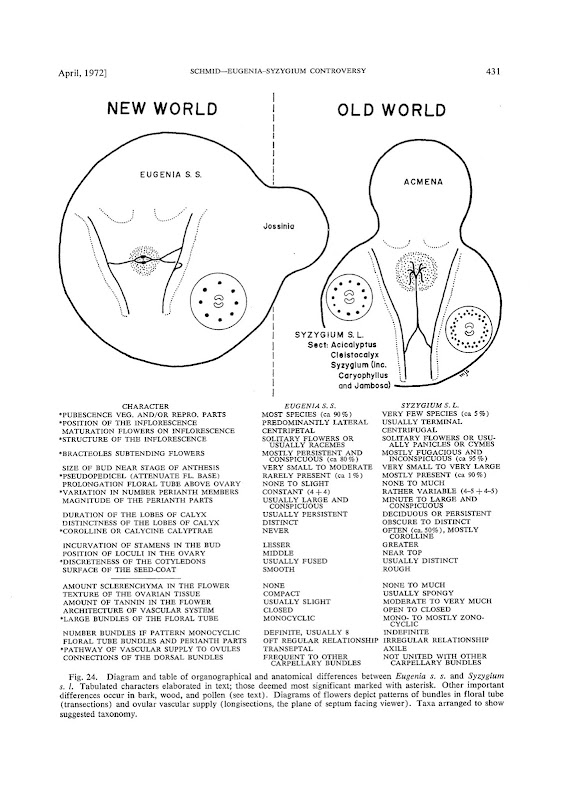
A Resolution of the Eugenia-Syzygium Controversy


ABSTRACT
Floral anatomy now provides additional, strong evidence confirming the distinctness of the mainly New World Eugenia s. s. and the strictly Old World Syzygium s. I. Most significantly, species of Eugenia s. s. have a transeptal vascular supply to the ovules whereas those of Syzygium s. I. have an axile one. Other features of floral histology and vasculature also support such a division. In addition, a review of the taxonomic literature revealed three hitherto neglected organographic criteria-nature of bracteoles, presence or absence of pubescence, and presence or absence of pseudopedicels-that sharply distinguish between Eugenia s. s. and Syzygium s. I. An ensemble of these and other organographic criteria further demonstrates the basic disparity of these taxa. The organography and histology of flowers of Eugenia s. I. are described in detail, with .26 characters contrasting the Old and New World species included in a table.


RUDOLF SCHMID, 1972, Amer. 1. Bot. 59(4): 423-436. 1972., Amer. 1. Bot. 59(4): 423-436. 1972.


Wednesday, 1 June 2016

Eucalyptus camaldulensis - River Red Gum

Eucalyptus camaldulensis is the river red gum, a tree of the Myrtaceae family.  It is native to Australia, where it naturally distributed along many inland water courses as well as floodplains.  Due to the proximity to watercourse, river red gum is subject to regulate flooding in its natural habitat.

The generic name ‘Eucalyptus’ is from the Greek words ‘eu’ good or well, and ‘kalyptos’ covered, referring to the calyx which forms a lid over the flowers when in bud.  Specific name “camaldulensis” referring to L’Hortus Camaldulensis di Napoli, from where the first specimen was first described by Frederick dehnhardt, in 1832.  The Camaldoli garden, which was established in 1816 by Francesco Ricciardi, Count Camaldoli, features collections of Acacia, Agavaceae, Melaleuca, Eucalyptus camaldulensis, and Quercus ilex.


River red gum is tolerant to waterlogging, as well as drought, salinity, fire and frost.  Globally, E. camaldulensis is widely planted in arid and semi-arid lands.

E. camaldulensis can grow up to 45 meters tall.  The tree has a large, dense crown.  The base of the bole can be covered with rough, reddish-brown bark.   The dull blue-green coloured leaves contain oil-producing glands in the un-veined areas. 


USES

Due to its fast-growing nature, it is cultivated for the wood.  Eucalyptus plantations are popular with honey producers, as they are safe and sheltered, and very few agro-chemicals are used.

River red gum wood is hard and dense (≈900kg/m3), but brittle, thus making hand working difficult.  It is used in rot resistant applications such as fence posts, sleepers, decks and wooden floors.  It is also popular firewood, the wood makes fine charcoal. 

E. camaldulensis is a natural biological drainage (biodrainage), often used to reclaim swampy sites.  The tree’s root can penetrate deep into the soil, capable to draw a tremendous amount of water from the ground, thus removing the water from the swamp.


HAZARDS

River red gum and many other Eucalypts was nicknamed, “widow maker”, as they tends to drop large branch without warning.  This form of self-pruning may be a means of saving water or simply a result of its brittle wood.

E. camaldulensis is known to exhibit allelopathic characteristic.  Several volatile and water-soluble toxins found in Eucalyptus tissues inhibit other plant species from growing nearby.  Accumulated Eucalyptus litters inhibit seeds germination, and stunted seedling growth.

Eucalypts draw a tremendous amount of water from the soil through the process of transpiration.  This may contribute to depletion of ground water and soil moisture.


Large amount of Eucalpytus litters, combine with the volatile oil produced by the leaves, lead to fire hazard in Eucalpytus plantation.  

Sunday, 3 January 2016

Jambu Epal... New Variety? Old Gimmick !


The ‘new variety’ of Jambu had been in the market for few years, but still many are not aware of its existence.

Visitors to Cameron Highlands will surely encounter this fruit at either Kea Farm or Brinchang night market.  Priced for a hefty RM10 for 3, it come in two attractive colours: Fuji-apple-red and granny-smith-green, vacuum packed in clear PE bags. 


Consumers Association of Penang ( CAP ) had in 2007 warned the public about this ‘new variety’ of guava.   According to CAP, the guava was actually normal jambu batu berbiji ( Psidium guajava ), peeled, soaked in coloured sugar solution.  The coloring agent used are E133 Brilliant Blue and E102 Tartrazine for the light green colour; and E122 Carmoisine for Fuji-apple red respectively.

The product is correctly labeled as ‘Jambu Jeruk’.  However, information on coloring agent is Ec177, which is non-existence.  Also, E509 Calcium Chloride is used.
  

Sunday, 14 June 2015

Leptospermum brachyandrum vs Baeckea frutescens

Leptospermum brachyandrum
Common names : teatree, Australian willow
Family : Myrtaceae
Origin : costal New South Wales, Australia
Description : small tree, up to 5m in heights ; 
grows on wet soil, full sun or part shade. 


 Baeckea frutescens
Common names : cucur atap, curan atap, hujung atap, cina maki
Family : Myrtaceae
Origin : costal and mountainous Malaya & Sumatra
Description : small tree, up to 3m in heights ; 
grows on wide range of soil. 


Sunday, 17 June 2012

WEST-meet-EAST 石榴

石榴,别名安石榴、海榴、pomegranate (英文)delima (马来)。学名 Punica granatum,属石榴科 ( Punicaceae ),于温带属落叶灌木,在热带成常绿树。果皮朱红色,亦有黄色和白色,球形。肉质半透明,多汁。含多维生素CB族维生素。

原产中东。相传是西汉 (100BC)  时由张骞从西域安国和石国 ( UzbekistanBuxoroToshkent )  引入中国,故名安石果。唐《藝文類聚》引西晋陸機《與弟雲書》:「張騫為漢使外國十八年.得塗林,安熟榴也。」

石榴全身是宝,果皮、根、花皆可入药。性温,味甘、涩、酸, 无毒。具有生津止渴,杀虫、收敛、涩肠、止痢等功效。


番石榴,别名鸡屎果、鸡屎拔、翻桃子、番桃、番稔、番鬼子、林拔、拔子、椰拔、木八子、芭乐、guava (英文), jambu batu (马来) 等。学名Psidium guajava,属桃金娘科 ( Myrtaceae ),是常绿小乔木。果皮翠绿至朱红,圆或椭圆形,多耔。果肉未熟脆口,乳白色。熟果肉质细嫩,色乳白至朱红。含多维生素C,钾,铁,胡萝卜素。

原产美洲热带。16世纪传播至世界各热带及亚热带地区。约17世纪传入中国。

番石榴性温,味甘、涩、酸, 无毒。 具有止泻,止血,止痒的功效。多食便秘 ,不宜多吃。