Showing posts with label Rubiaceae. Show all posts

Monday, 1 July 2013

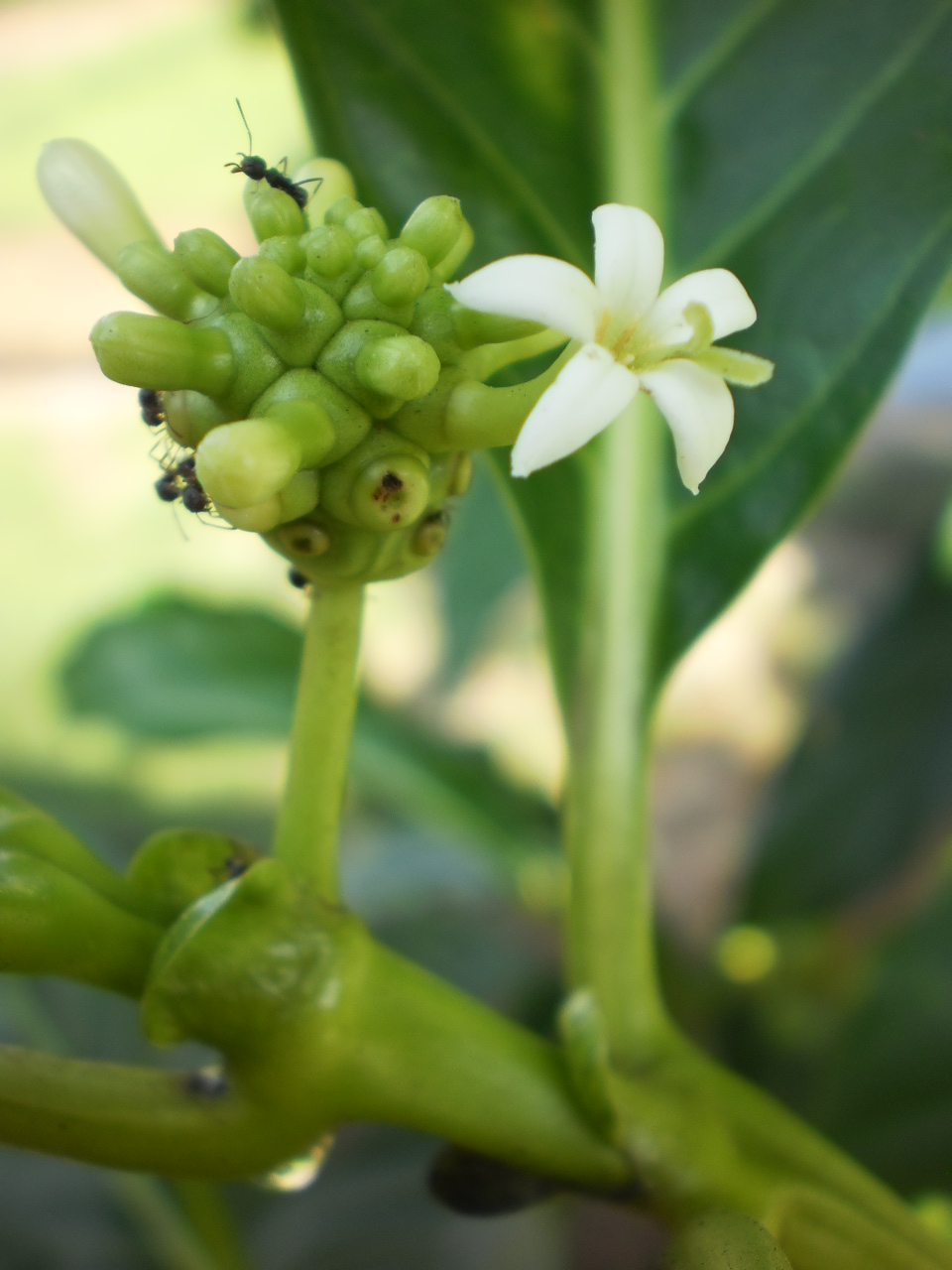
Morinda citrifolia - Mengkudu

Noni or mengkudu is Morinda citrifolia.  It is a shrub of the Rubiaceae family, native from Southeast Asia and Australasia.

From the look of it, it is obvious that mengkudu is a multiple fruit.  It is green when young, and turn yellowish or whitish  upon ripening.  Ripened fruit has a strong pungent odour, distasteful for some.   Despite its strong smell and bitter taste, the fruit is nevertheless consumed as a famine food, in some Pacific islands, as a staple food.  The seeds are edible when roasted.

Morinda citrifolia fruit contains moderate amount of carbohydrate and dietary fibre.  It also contains vitamin A, vitamin C, niacin, iron, potassium, calcium and sodium. 

The fruits are studies for its phytochemical compounds : lignans, oligo- and polysaccharides, flavonoids, iridoids, fatty acids, scoploetin, catechin, beta-sitosterol, damnacantha, and alkaloids.  Although no conclusive evidence of the fruit on human health, the Polynesian uses the green fuits, leaves and roots to treat menstrual cramps, bowel irregularities, diabetes, liver diseases and urinal tract infections.  


Brownish-purplish dye is extracted from its bark for batik-making.  In Hawaii, yellowish dye is extracted from its root.


Wednesday, 10 August 2011

Jasmine is not Just Jasmine

Jasmine is a genus of shrubs and vines in the Oleaceae family, with about 200 species, native to tropical and warm temperate regions of the Old World. 

The most famous is probably Jasminum sambac, the Arabian jasmine.  Despite its English common name, J. sambac is not originally native to Arabia.  It was from South and S.E. Asia, and were spread into Arabia.  From there, they were introduced to Europe. 


Jasminum sambac
Family : Oleaceae
Common name : Arabian Jasmine, 茉莉花
Description : evergreen shrub, flower : white, fragrant, clusters, zygomorphic, multiple petals, full bloom at night
Origin : South Asia, S.E.Asia
Uses : ornamental, jasmine tea, national flowers of the Philippine & Indonesia, leis, corsages, crowns


The word 'jasmine' also loosely refers to many other flowers not of Jasminum genus or Oleaceae family.  

Cestrum nocturnum
Family : Solanaceae
Common name : Night-blooming Jasmine, lady of the Night, 夜来香,夜香木
Description : evergreen woody shrub, flower : greenish-white, cymose inflorescences, zygomorphic, tubular corolla 5 lobed, full bloom at night
Origin : tropical America
Uses : ornamental

Gardenia jasminoides
Family : Rubiaceae
Common name : Cape Jasmine, Common Gardenia, 栀子花
Description : evergreen woody shrub, flower : white, fragrant, solitary, zygomorphic, multiple petals
Origin : Asia
Uses : depicted in Chinese paintings, fruit for Chinese traditional medicine & dye, ornamental

Gelsemium sempervirens
Family : Gelsemiaceae
Common name : Yellow Jasmine, Carolina Jasmine, Evening Trumpet flower, Woodbine
Description : evergreen liana, flower : yellow, fragrant, clusters, zygomorphic, bell-shaped, corolla 5 lobed
Origin : tropical America
Uses : ornamental, toxic, state flower of South Carolina

Millingtonia hortensis
Family : Bignoniaceae
Common name : Tree Jasmine, Indian Cork Tree, 烟筒花
Description : evergreen tree, flower : white, fragrant, panicles, bisexual, zygomorphic, long tube, corolla 5 lobed
Origin : S.E.Asia
Uses : wood for timber, bark for cork, leaves for tobacco substitute

Nyctanthes arbor-tristis
Family : Oleaceae
Common name : Night Flowering Jasmine, Coral Jasmine
Description : evergreen shrub, flower : white with orange-red center, fragrant, cluster of 2-7, zygomorphic, 5-8 lobed, full bloom at night
Origin : Southern Asia
Uses : Ayurvedic medicine

Trachelospermum jasminoides
Family : Apocynaceae
Common name : Star Jasmine, Confederate Jasmine, Trader’s Compass, 络石 , 百花藤
Description : evergreen liana, flower : white, fragrant, clusters, zygomorphic, tube-liked, corolla 5 lobed
Origin : East Asia
Uses : ornamental

Friday, 6 May 2011

Uncaria gambir - Gambir

Gambir, Uncaria gambir is a member of Rubiaceae family.  It is a climber plant, uses hooks derived from reduced branches, to cling to other vegetation.  

Uncaria is a genus of some 40 species.  Uncaria was named in 1789 by Johann von Schreber in his 8th Edition Genera Plantarum. 'Uncaria' derived from Latin word ‘uncus’ which means “a hook”, in allusion to its hooks .

Gambir is extracted from the leaves.   The leaves are first boiled in water, mechanically pressed to squeeze out the liquid.  The liquid is then dried to semi-solid paste, and then dried in the sun.

Gambir is used for chewing with areca and betel in most S.E.Asian country.

Gambir is said to have some anesthetic property.  Natives of Sarawak use gambir for treating toothache, insect bites, ear piercing etc.  However, the most well known usage of Sarawak’s gambir is most probably to prolong erection during sexual intercourse.   Though there are no medical report to support the effectiveness of gambir in prolong erection, there are no evidence to suggest otherwise either. 

Saturday, 17 April 2010

Sekapur Sirih


The tradition of eating betel can be trace back to more than 3,000 years ago. It’s practiced from various groups ranging from the poor, the nobles, the royal and even the children..

The tradition is said to be originated from India. Some said It’s from Indonesian islands, but Malaysian Malays claims that they started the tradition without external influence. Nevertheless, it’s an important cultural activity in many Asian and Oceanic countries..

The normal ingredient of betel chewing consists of betel leaf ( leaf of Piper betle ), betel nut ( fruit of Areca catechu ), kapur and gambir ( extract of Uncaria gambir’s leaves )..

Betel leaf / Sireh ( Piper betle ) is a perennial creeper belong to the Piperaceae family. The plant originated from South & S.E.Asia. Betel oil contains chavitetol, chavicol, estragole, eugenol, methyl eugenol and hydroxycatechol. .
It is use fresh to wrap the betel nut, kapur and gambir for chewing. .

Betel nut / Pinang ( Areca catechu ) is a species of palm tree originated from S.E.Asia. The seed contains arecain and arecoline, which is intoxicating and slightly addictive, also claimed to be link to oral cancers. .

The alkaloid arecoline in betel nut acts as stimulant to promote salivation.
..
Kapur / slaked lime is from grind shell in a little liquid. It is Calcium hydroxide with molecular formuala Ca(OH)2.
.
The lime acts to keep the active ingredient in its freebase form, thus enabling it to enter the bloodstream via sublingual absorption..

Gambir ( Uncaria gambir ) is a shrub from the family Rubiaceae. Native to S.E.Asia . It contains many catechins which are known to have many medicinal properties and are components of Chinese herbal remedies..

To make gambir, the leaves are first boiled in water, then pressed to squeeze and extract the liquid. The liquid is then dried into a semi-solid paste and molded into cubes, which are dried under the sun.