Showing posts with label Fabaceae ( legume family ). Show all posts

Monday, 10 August 2020

Acacia sensu lato in East & Southeast Asia


Tuesday, 28 July 2020

Fabaceae

the Fabaceae or Leguminosae, commonly known as the legume, pea, or bean family, are a large and economically important family of flowering plants. It includes trees, shrubs, and perennial or annual herbaceous plants, which are easily recognized by their fruit (legume) and their compound, stipulate leaves. Many legumes have characteristic flowers and fruits. 

The family is widely distributed, and is the third-largest land plant family in number of species, behind only the Orchidaceae and Asteraceae, with about 751 genera and more than 20,000 known species.

The Fabaceae are placed in the order Fabales according to most taxonomic systems, including the APG III system.  The family now includes six subfamilies:
Cercidoideae: 12 genera and ~335 species.  
Detarioideae: 84 genera and ~760 species.    
Duparquetioideae: 1 genus and 1 species.  
Dialioideae: 17 genera and ~85 species.  
Caesalpinioideae: 148 genera and ~4400 species.  
Faboideae (Papilionoideae): 503 genera and ~14,000 species.  


The Legume Phylogeny Working Group, Hawkins, J. A. and Mattapha, S. (2017)  A new subfamily classification of the Leguminosae based on a taxonomically comprehensive phylogeny. Taxon, 66 (1). pp. 44­77. ISSN 0040­0262 .https://doi.org/10.12705/661.3.   http://centaur.reading.ac.uk/69376/ 

López-Romero, J. 2019. Sinopsis del género Chamaecrista en Colombia. Pp. 165-246. En: Forero, E. & C. Castellanos (eds.),Estudios en Leguminosas Colombianas III. Biblioteca Jorge Álvarez Lleras Nº 37. Academia Colombiana de Ciencias Exactas, Físicas y Naturales, Colombia.  https://www.researchgate.net/publication/337884782_Colombian_Legume_Genera_and_their_Placement_in_the_New_Six_Subfamily_Classification_of_Leguminosae


Saturday, 22 February 2020

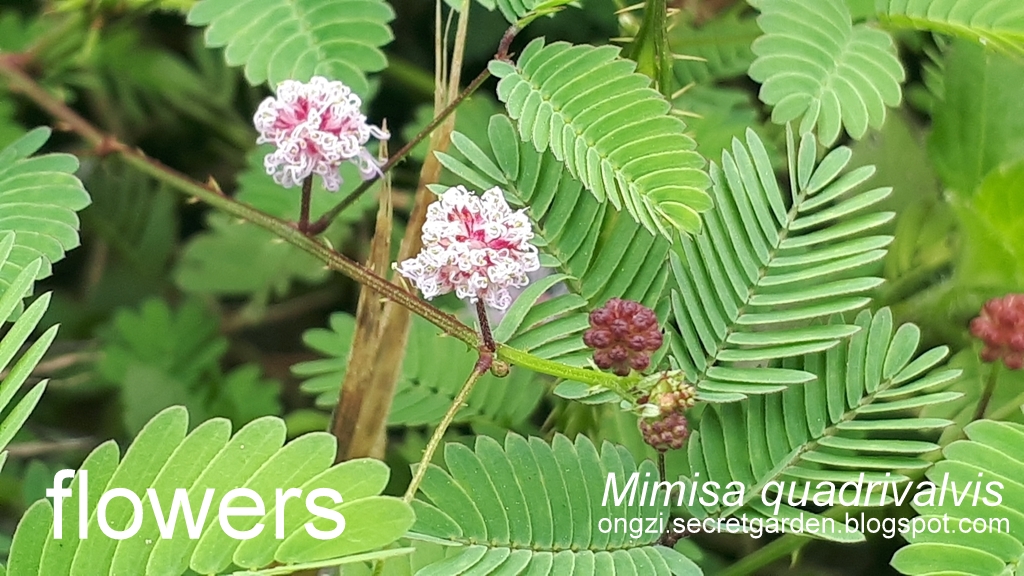
Mimosa quadrivalvis

Mimosa quadrivalvis L(L.) Merr.
Fourvalve mimosa


native :
tropical America and the Caribbean


Synonyms
Leptoglottis quadrivalvis (L.) Britton & Rose
Morongia aculeata A.Heller
Schrankia aculeata Willd.
Schrankia mexicana Raf.
Schrankia quadrivalvis (L.) Merr.


varieties :
Mimosa quadrivalvis var. angustata 
Mimosa quadrivalvis var. floridana  
Mimosa quadrivalvis var. hystricina
Mimosa quadrivalvis var. nelsonii 
Mimosa quadrivalvis var. leptocarpa 
Mimosa quadrivalvis var. quadrivalvis          
Mimosa quadrivalvis var. urbaniana 

Wednesday, 21 August 2019

Acaciella angustissima

Acaciella angustissima ( white ball acacia) is a highly variable perennial shrub native to subtropical and tropical America.

Nomeclature

The name Acaciella is diminutive of the genus Acacia

Angustissima is the ablative feminine singular of angustissimus, which means narrowest or very narrow, depicting its narrow leaflets.

Varieties

Acaciella angustissima var. angustissima (Mill.) Britton & Rose
Acaciella angustissima var. chisosiana Isely
Acaciella angustissima var. filicioides (Cav.) L. Rico
Acaciella angustissima var. hirta (Torrey & A.Gray) Robinson
Acaciella angustissima var. shrevei (Britton & Rose) Isely
Acaciella angustissima var. suffrutescens (Rose) Isely
Acaciella angustissima var. texensis (Torrey & A.Gray) Isely


Synonyms

Acacia angulosa Bertol.
Acacia angustissima (Mill.) Kuntze
Acacia elegans M.Martens & Galeotti[2]
Acacia filicina Willd.
Acacia filicioides (Cav.) Trel.
Acacia glabrata Schltdl.
Acacia hirsuta Schltdl.
Acacia insignis M. Martens & Galeotti
Acacia pittieriana Standl.
Acacia villosa (Sw.) Willd.

Acaciella angulosa (Bertol.) Britton & Rose
Acaciella costaricensis Britton & Rose
Acaciella holtonii Britton & Killip
Acaciella martensis Britton & Killip
Acaciella rensonii Britton & Rose
Acaciella santanderensis Britton & Killip
Acaciella villosa (Sw.) Britton & Rose

Mimosa angustissima Mill.
Mimosa filicioides Cav.
Mimosa ptericina Poir.


History

1768 - first described as Mimosa angustissima.
1896 - transferred to the genus Acacia by Kuntze.
1928 - Britton and Rose proposed a new genus Acaciella
2006 - Rico Arce and Bachman confirmed the genus Acaciella.  
15 species described in America.


Description

Acaciella angustissima is morphologically highly variable.

The following description is of the typical form of the species ( A. angustissima var. angustissima), which was described by  Rico Arce and Bachman in 2006 :

A thornless shrub or small tree usually growing 2–7 m tall with a single short trunk. However, it may very rarely reach up to 12 m in height.


Its younger stems are hairless or finely hairy and are usually somewhat striate

The leaves are bipinnate, 10–21 cm long, and usually have 10–17 pairs of pinnae.  They are borne on stalks 1.2–3.5 cm long that are sparsely strigulose. The pinnae are 2.5–5 cm long and each bears 20–40 pairs of leaflets. These relatively narrow leaflets are small (2.4–5 mm long and 0.5–2 mm wide) with pointed tips and entire margins.


Stipules are inconspicuous (2–2.5 mm long).

The whitish flower clusters are globular or ellipsoidal in shape (1–1.5 cm across) and are actually short head-like racemes. They are borne on short peduncles (1–1.5 cm long) and arranged in axillary fascicles, which may sometimes be arranged into larger panicle-like inflorescences.


The flat, thin-walled, papery, pods are oblong in shape (3–9 cm long and 6–15 mm wide) with straight or sinuate margins. They are initially green (Figure 5), but turn coffee-brown when ripe. These glabrous pods are acute at the base and apex, with a stipe 7–12 mm long and a beak 2–7 mm long.

Each pod contains 8–12 circular seeds 2.5–3.2 mm across. These seeds are arranged transversely in the pod and are clearly separated from each other. Seed production is prolific. Seed weight is 90 000–100 000 seeds/kg.


Sunday, 19 November 2017

Wayside Alien Fabaceae ( Mimosoideae ) @ Seremban2

Leucaena leucocephala ( petai belalang ) has been described as a ‘miracle tree’ for its multiple uses, yet also dubbed as a ‘conflict tree’ as a noxious weed.

Described as the world’s most widely used forage tree legume by FAO, L. leucocephala in an excellent source of high-protein fodder for animal feed and excellent firewood, and efficient in nitrogen fixation.  The young shoots, young pods, and mature seeds are consumed as food for human.  However, it contains mimosine, a toxic amino acid to non-ruminant vertebrates.

Yet, it is listed as one of the 100 worst invasive alien species by IUCN Invasive Species Specialist Group.  It can grow wide range of soil and rainfall environment, grows quickly and forms dense thickets and produces large quantity of seeds.

Key words : allelopathic, N-fixation, mimosine. 


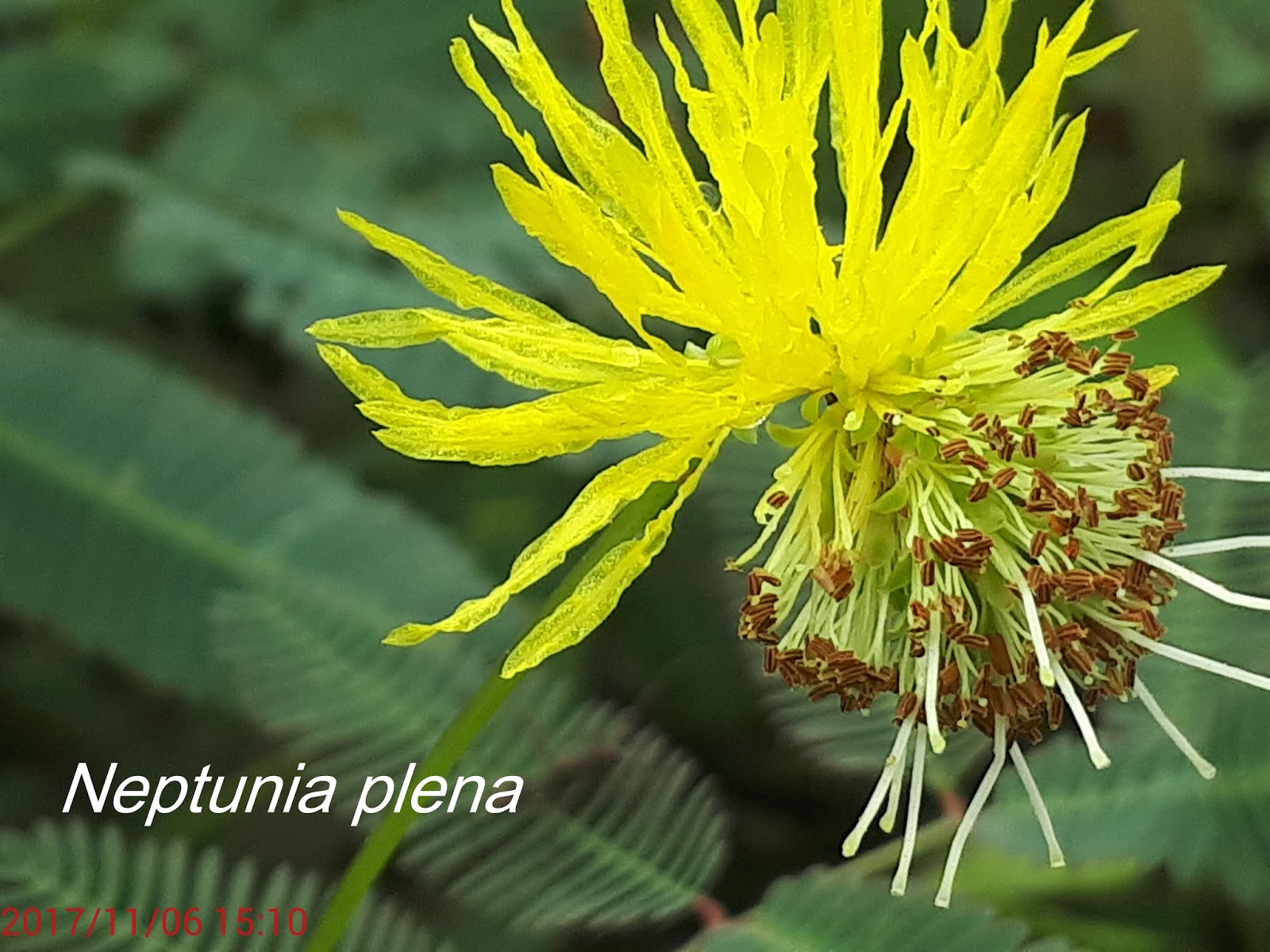
Neptunia plena ( aquatic sensitive plant ) is an invasive plant thriving on waterlogged area and watercourses.  It is not confined to wetlands but tolerates considerable flooding.  During dry period, the plants become dormant and persist as seeds.  It can lead to increased algal blooms reduce water quality by preventing light penetration and reduce oxygenation of water. 

N. plena and N. oleracea are both referred as ‘water mimosa’.  Water mimosa is a restricted invasive plant under Queensland’s Biosecurity Act 2014.

Key words : allelopathic, N-fixation, mimosine. thigmonasty


Mimosa pudica ( sensitive plant )  is most probably the well-known for its rapid plant movement.  It is most often grown as potted plants for its curiosity value.  It also became an ideal plant for experiments regarding plant habituation and memory.

M. pudica has been listed in the Global Invasive Species Databease 2010.

Key words : allelopathic, N-fixation, nyctinastic, mimosine. thigmonasty


Mimosa diplotricha ( giant sensitive plant ) includes 3 varieties : diplotricha, odibilis and inermis

Although M. diplotricha is an excellent ground cover and green manure, it is restricted invasive plant under Queensland’s Biosecurity Act 2014.

Key words : allelopathic, heliophytic, N-fixation, nyctinastic, mimosine. thigmonasty


Sunday, 7 December 2014

Desmodium triflorum


Desmodium triflorum
Synonym : Hedysarum triflorum, Meibomia triflora

Origin & Distribution 
Desmodium triflorum is native to ther Old World tropics and subtropics.   It is currently pantropical.


Environmental Significance
Capable to grow on wide range of soil, tolerant to draught and fire, highly resistant to grazing and mowing, thus very difficult to get rid of.
Considered invasive and notorious weed, especially for lawn.


Saturday, 17 May 2014

Albizia saman - Rain Tree

Rain tree is Albizia saman, more fondly known as its obsolete name Samanae saman, a tree originated from the Neotropics, range from Mexico to Peru and Brazil.  However, it is widely introduced to South and SE Asia, as well as the Pacific Islands.

The generic name Albizia is to honor an Italian nobleman Filippo degli Albizzi, who introduced Albizia julibrissin to the Europe in the mid-18th century.  The specific name saman is from the Spanish word originated from South American aboriginal name zamang.

The name ‘rain tree’ was coined in India, due to the possible excreta of cicada inhabiting the trees.    It Hawaii, its known as ‘monkeypod’.   Its common name varies in different regions and different languages.

Albizia saman F.Muell. was known as by numerous synonyms :
·Acacia propinqua A.Rich.
·Albizzia saman (Jacq.) Merr. (orth.var)
·Calliandra saman (Jacq.) Griseb.
·Enterolobium saman (Jacq.) Prain
·Feuilleea saman (Jacq.) Kuntze
·Inga cinerea Willd.
·Inga salutaris Kunth
·Inga saman (Jacq.) Willd.
·Mimosa pubifera Poir.
·Mimosa saman Jacq.
·Pithecellobium cinereum Benth.
·Pithecellobium saman (Jacq.) Benth.
·Pithecellobium saman var. saman (Jacq.) Benth.
·Pithecolobium saman (Jacq.) Benth.
·Samanea saman (Jacq.) Merr.
·Zygia saman (Jacq.) A.Lyons


Albizia saman is a wide canopied tree with a large symmetrical crown of up to 20m in diameter.  It can reach a height of 25m and trunk diameter of 40cm. The bark is gray, rough, thick, furrowed.  Its leaves are alternate, bipinnate with diamond-shaped leaflets.  Flowers are in clusters, pink to yellow, depending on its lineage.   Seed pods are long, 10-20cm long.  Seeds oblong, reddish brown.


The large crown provides a nice canopy, thus often planted in parks.  It can also planted in row along road shoulders.  Yet, the large branches tend to break off.  The vast root system also often found damaging roads, drains, pedestrian walkway and buildings.


Monday, 1 July 2013

Milletia speciosa - 山莲藕

山莲藕,又名大力牛、牛大力、大口唇、扮山虎、扒山虎、坡蓮藕、地藕、大蓮藕、血藤、大力薯、倒吊金鐘。为豆科植物美丽崖豆藤 Milletia speciosa  Champ. 的根。夏、秋间采挖,晒干。

山莲藕为偃伏生灌木,树皮褐色。羽状复叶。 花白色,雜有黃色。


根含淀粉甚丰富,可酿酒,又可入药,有通径活络,补虚润肺和健脾的功能。性味甘,寒。

Thursday, 1 November 2012

Lablab purpureus - Kacang komak


Kacang komak is the name the Indonesian workers called the rare purplish bean they sowed at the line site.

It is a vigour climber with trifoliate leaves.  Flowers in raceme, purplish-green in colour, resemble of yardlong beans ( Vigna unguiculata sesquipedalis ).
Yet the fruit pods are somehow similar to semi-inflated green beans.

A check on Google shows that kacang komak is a variety of Lablab purpureus (L.) Sweets, a legume native to Africa, now widely cultivated throughout tropical region.

It is known by many names : Egyptian been, Hyacinth bean, Indian bean ; faselbohne, helmbohne, schlangenbohne, batao, wal,vaal, sem, lubia, fiwi, njahi in Africa ; batao in the Philippines ; avarai in India, etc.  Its synonyms include : Dolichos benghalensis Jacq. Dolichos lablab L. , Dolichos purpureus L. , Lablab niger Medikus , Lablab vulgaris (L.) Savi , Lablab lablab (L) Lyons,  Vigna aristata Piper.

Flowers, immature pods, seeds, leaves and root are used as vegetables.  Flowers are consumed raw or cooked in soups. Immature pods can be eaten raw or cooked.  Mature seeds must be thoroughly cooked.  The seeds can also made into tofu, tempe, or sprouted.  Leaves must be cooked before consuming.

It is also used as fodder for grazing, in soil conservation, as green manure and cover crop, and even as an ornament.


Wednesday, 4 July 2012

3 Sisters

This diorama depicts the type of agriculture the Iroquois practiced when Europeans came to what is now Upstate New York, beginning about 1600. This exhibit strives to be authentic in all respects, from the major setting to the small details. The plants and animals displayed are accurate replications of those that inhabited the Iroquois world.


The Three Sisters are the three main agricultural crops of Native American in North America : squash, maize and beans.

The three crops are planted close together in the field.  maize are planted on flat-topped mounds ( 30cm height x 50cm width ) of soils.  Rotten fish or eels are buried in the mound for fertilizer.  When the maize is 15cm tall, beans and squash are planted alternately around the maize.

The maize provides a structure for the beans to climb, eliminating the need for poles.  The beans would provide nitrogen to the soil.  The squash spread over the ground, blocking the sunlight, establishing a living mulch.

Maize lacks the amino acid lysine and tryptophan, of which beans rich in.  therefore maize and beans together provide a balanced diet.


Squash

Squashes generally refer to 4 species of the genus Cucurbita : C. maxima ( ambercup, buttercup squash, Hubbarb squash ), C. mixta ( cushaw squash ), C. moschata ( butternut squash ), and C. pepo ( acorn squash, pumpkins, pattypan squash, yellow crookneck squash, spaghetti squash, summer squash, zucchini )

Squashes may have been first cultivated in Mesoamerica some 8,000 to 10,000 yeas ago.

In North America, squashes are loosely grouped into summer squash or winter squash, depending on whether they are harvested as immature fruit ( summer squash ) or mature fruit ( autumn or winter squash ).


Summer squashes are harvested during immature stage, while the skin is still soft and the fruit is rather small.  They are eaten almost immediately and require little to no cooking.  Summer squashes include : pattypan, yellow crookneck, zucchini.

Winter squashes are harvested generally during the end of summer, cured to further harden the skin, and stored in cool place.  Winter squashes include : butternut squash, Hubbard squash, ambercup, acorn, spaghetti squash, and pumpkin.

Squashes derived from an inferior ovary, are botanically classified as a pepo, which is a special type of berry with a thick outer wall or rind formed from hypanthium tissue fused to the exocarp ; the fleshy interior is composed of mesocarp and endocarp.


Maize

Maize is domesticated in Mesoamerica as early as 10,000BC.  By 2,500 BC, it had spread through much of the Americas. In the late 15th and early 16th centuries, European explores bring maize back to Europe and introduced it to other part of the world.

Sugar-rich varieties are called sweet corn, are usually grown for human consumption ; while field corn varieties are used for animal feed and as chemical feedstocks.

Maize are classified as various subspecies related to the amount of starch each has :
· flour corn – Z. mays amylacea
· popcorn – Z. mays everta
· dent corn – Z. mays indentata
· flint corn – Z. mays indurate
· sweet corn – Z. mays saccharata, Z. mays rugosa
· waxy corn – Z. mays ceratina
· pod corn – Z. mays tunicata
· striped maize – Z. mays japonica

Botanically a caryopsis,  the kernel of maize seed has a pericarp of fruit fused with the seed coat. 


Beans

Beans were domesticated in Mesoamerica some 2,000BC ago.  5 kinds of Phaseolus beans were domesticated by pre-Columbian peoples : P. vulgaris ( common beans, caparrones, pinto bean, kidney bean ), P. lunatus ( lima beans, seiva beans ), P acutifolius ( Tepary beans ), P. coccineus ( scarlet runner beans ), and P. polyanthus ( polyanthus beans ).

Beans contain a toxic compound phytohaemagglutinin.  The concentration varies in many varieties.  Phytohaemagglutinin can be deactivated by boiling beans in water, which should then be discarded.  Symptoms of phytohaemagglutinin poisoning are nausea, vomiting and diarrhea.

Beans are also high in purines, which metabolized to urid acid.  Urid acid promotes the development of exacerbation of gout.

Beans are legumes, having dicotyledon seeds in pods.


Rocky Mountain bee plant

The Tewa and other Southwest tribes often include a ‘fourth sister” known as Rocky Mountain bee plant ( Cleome serrulata ), which attracts bees to help pollinate the beans and squash.  Its seeds can be eaten raw or cooked, or dried and ground into meal.  The leaves, flowers and shoots can be cooked and eaten as vegetable.  An infusion of the plant is used to treat stomach problems and fevers, and poultices made from it can be used on the eyes.  A dye, called ‘waa’ in the Navajo language, is extracted from the plant, for painting pottery.


Friday, 3 June 2011

Leucaena leucocephala - Petai Belalang

Leucaena leucocephala (Lam.) De wit is a tropical species of small tree native to South America.  It is known as petai belalang in Malay language.  In Indonesia, it is known as lamtoro.

The specific name is derived from Greek word λευκό which means “white” ; and κέφαλος which means “head”, in allusion to its flowers.

Symnonyms : Acacia leucocephala (Lamark) Link 1822, Leucaena glabrata Rose 1897, Leucaena glauca (L.) Benth 1842, Mimosa leucocephala Lamark 1783

There are 3 subspecies : subsp. leucocephala, subsp. glabrata, and subsp. ixtahuacana.


L. leucocephala can grow up to 20 meter in height. 
The leaves are bipinnate.  Leaflets are  9-16mm long and 2-4mm wide.
Flowers are actinomorphic, about 12-21mm diameter, cream white colour, 10 free stamens per flower, hairy anthers.
Pod occure in cluster of 5-20 per flower head, 11-19cm long, 15-21mm wide, flattened, 8-18 seeds per pod, dehiscent.
Pollination via insects, self-fertile.
Propagation via seeds.  Seeds can remain viable for long periods ( at least 20 years ) in the soil.
Trees are generally short-lived ( 20-40 years )

It can grow in wide range of habitats : coastal, riverine, semi-natural, ex-mining, disturbed sites etc

L. leucocephala is susceptible to the psyllid Heteropsylla cubana, which cause serios defoliation and mortality.
Gummosis caused by Fusarium semitectum
Ganoderma lucidum causes root rot.

L. leucocephala is efficient in nitrogen fixation, at more than 500kg/ha/year.
The leaves are highly nutritious for ruminants.
The wood is used as firewood, and produced into charcoal.  It can also be used for parquet flooring, furniture, as well as paper pulp.  Straight trunk is used as posts.
L. leucocephala thickets are used as windbreeakers and firebreakers.
The young seeds and young leaves are consumed as vegetables.
In Indonesia, ‘tempe lamtoro’ is made of fermented leucaena seeds.
However, due to its high germination rate and growth rate, it is sometime regard as noxious weeds.

The leaves and seeds contain mimosine, a toxic to non-ruminant vertebrates, thus not advisable to consume in large quantity. 
Mimosine is broken down in the rumen to DHP ( 3-hydroxy-4-(1H)-pyridone ), which is further broken down by rumen microorganisms to non-toxic compounds.


Reference