Friday, 6 May 2011

Uncaria gambir - Gambir

Gambir, Uncaria gambir is a member of Rubiaceae family.  It is a climber plant, uses hooks derived from reduced branches, to cling to other vegetation.  

Uncaria is a genus of some 40 species.  Uncaria was named in 1789 by Johann von Schreber in his 8th Edition Genera Plantarum. 'Uncaria' derived from Latin word ‘uncus’ which means “a hook”, in allusion to its hooks .

Gambir is extracted from the leaves.   The leaves are first boiled in water, mechanically pressed to squeeze out the liquid.  The liquid is then dried to semi-solid paste, and then dried in the sun.

Gambir is used for chewing with areca and betel in most S.E.Asian country.

Gambir is said to have some anesthetic property.  Natives of Sarawak use gambir for treating toothache, insect bites, ear piercing etc.  However, the most well known usage of Sarawak’s gambir is most probably to prolong erection during sexual intercourse.   Though there are no medical report to support the effectiveness of gambir in prolong erection, there are no evidence to suggest otherwise either. 

Baphia nitida

Baphia nitida, common name camwood, African sandalwood, originated from West Africa.  It is of subfamily Faboideae  of family Fabaceae ( legume family ). 

The genus name Baphia is from Greek word ‘baphe’ which means dye, of which the wood yields red dye.  Species name ‘nitida’  refer to its leaves which are shining. 

It is a shrubby tree capable to grow up to 5 meter under full sun.  Tolerate to shade.
Flower is white, with yellow center.  Fruit pod dehiscent, with 2 -3 seeds inside.

There are records of propagation via seeds.  But I seldom encounter any fruiting, eventhough yes, viable seeds. Thus never attempted propagation via seed germination.
However, propagation with air-layered is highly successful. 
B. nitida requires plenty of water to thrive.  It grows well on well-drained soil.  Growth is stunted under water-logged soils.

Its wood is commonly used to make red dye.  The dye is of brilliant colour, but not permanent. 
The wood is also used in making knife handles, violin bows, and personal items.
B. nitida is also use in landscaping, as boundary plant, sound barrier, and hedges.


Thursday, 5 May 2011

Cayratia trifolia - Lakom

Cayratia trifolia ( synonym Vitis triloba) is a liana plant from the family Vitaceae. Native to Australia and Asia.

Leaves trifoliolate.
Flowers are small greenish white.
Fruits are about 1cm diameter, flesh and juicy, green, turn dark puple as they ripen.

Unripen mature fruits are sour, usually used in cooking as flavouring.


reference :
1988, Voon BH, Sim Patricia & Chin TH, Sayur-sayuran Dan Buah-buahan Hutan di Sarawak, Department of Agriculture, Sarawak.

Friday, 29 April 2011

Dialium indum - Keranji

Buah keranji ( Malay ) is Dialium indum ( a.k.a.  D. cochinchinenses, D. laurinum ), also known as velvet tamarind, and luk yee ( Thai ).  It is a member of subfamily Caesalpinioideae of family Fabaceae.

Keranji is native to S.E.Asian.  Supposedly closely associated with the local Malays, as it was featured in a popular Malay poem ( pantun ). 

The Malay pantun reads like this :
“Sorong papan tarik papan
Buah keranji di dalam perahu
Suruh makan engkau makan
Suruh mengaji engkau tak tahu”


A search in internet found very little information of the fruit.  Nevertheless, the name ‘keranji’ is familiar within local community, often used in name of places, roads, even apartments & housing estates, yet not many had actually seen or tasted the fruit, especially the younger generation.

During the 1980s, kids back then have not much choice of snacks.  Keranji was one of the cheapest, somehow palatable and fun too.   Two person with a handsome stock of keranji would play a game  of ‘keranji-fighting’.   Each holding a keranji and push toward each other, whomever’s keranji cracks, shall surrender the bet, normally a keranji.   

The fruit is edible, has a powdery texture, taste sweet and sour, similar to tamarind ( Tamarindus indica ).   Fresh fruit’s skin is dark blue in colour.  The fruit of oval shape.  When fresh, the flesh is of light brown in colour, turning darker when aged.

Yet, no records of extensive cultivation reported.  The keranji fruits occasionally found in local market may be of wild stands. 


Thursday, 28 April 2011

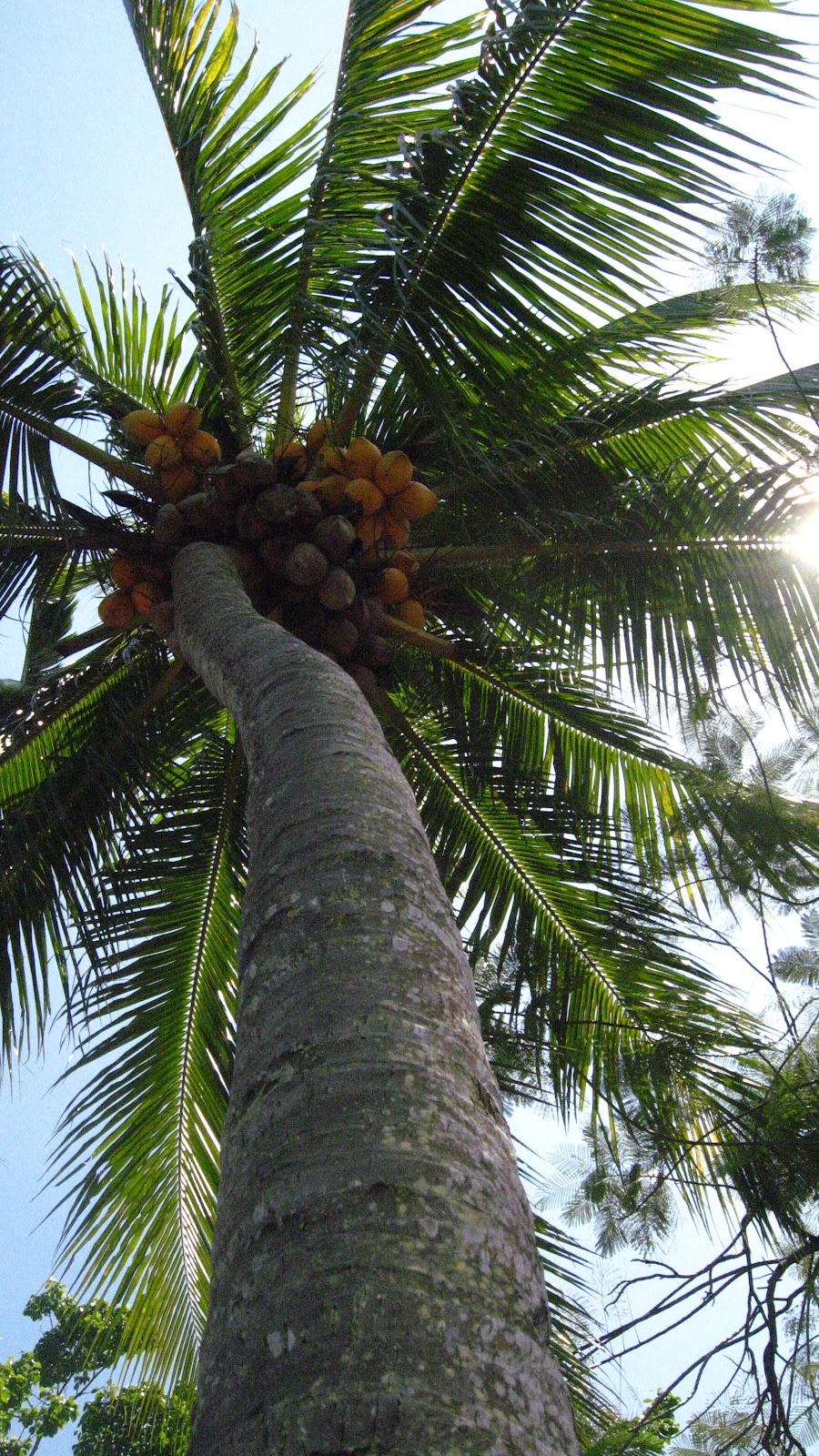
Cocos nucifera - Coconut

Coconut , Cocos nucifera is a member of the family Arecaceae ( Palmae – palm family ).  It is the only accepted species in the genus Cocos.    The term coconut can refer to the entire coconut palm, the seed, or the fruit.

Found across most part of the tropics, coconut is known for its great versatility in the many uses of its different parts.  
Its endosperm is know as the edible ‘meat’ of the fruit, when dried, it is called copra ; 
the oil and milk derived from the ‘meat’ are commonly used in cooking and frying ; 
coconut oil can made into soaps and cosmetics ; 
coconut water is a refreshing drink, and can be processed into alcoholic drink ; 
the sap derived from incising the flower cluster can be processed into palm sugar, and alcoholic drink ; 
apical buds of adult palm, known as ‘heart of palm’ are harvested for consumption, are a rare delicacy ; 
the husks can be processed into fiber for use in ropes, mats, brushes sacks, mattresses, mulching, and building material ; 
fresh leaves are weaved into shell as a container to fill rice and cooked to make ketupat ; 
dried leaves can be made into brooms, roofing ; 
husks and shells can be used for fuel and made into charcoal ; 
trunk are used for house construction, building small bridge ; etc

Botanically, the coconut fruit is a drupe, not a true nut.  Like other fruits, it has 3 layers ; exocarp ( skin ) , mesocarp ( husk ), and endocarp ( hard shell containing endsperm )


Ceibo pentrandra - Kekabu

Kekabu ( in Malay ) is Ceiba pentrandra, a tropical tree of the family Malavaceae ( previously a member of Bombacaceae.   Bombacaceae is not recognized by the APG I 1998, APG II 2003 and Kubitzki System 2003 as a family, instead as a subfamily Bombacoideae within Malavaceae sensu lato  ) , native to tropical America.   Another variety, Ceiba pentrandra var. guineensis, native to tropical west Africa.   It is mostly known as Kapok.

The tree grows up to 60 – 70 m tall.  The leaves are compound of 5 – 9 leaflets, each up to 20cm length.  The fruit is about 15cm in length, dehiscent.  The seeds surrounded by a fluffy, yellowish fiber that is a mix of lignin and cellulose.


USES

The fibre is light, buoyant, resilient and resistant to water.  It is difficult to spin thus is used as an alternative as filling in mattresses, pillow, stuffed toys, and for insulation.  

Seeds produced oil used in soap making.


CULTURE

The tree is the official national tree of Puerto Rico and Guatemala.

The Honduran city of La Ceiba, and Puerto Rican town of Ceiba were named after this tree.

It is a sacred symbol in Maya mythology