Showing posts with label Seremban. Show all posts

Sunday, 11 June 2023

Malaya : Rubber Pioneers

 Singapore
June 11th 1877
22 rubber seedling send from Kew Gardens to Singapore.
11 planted in Botanic Gardens Singapore
              
Kuala Kangsar
October 1877
Sir Hugh Low  ( 3rd Resident of Perak ) planted 9 rubber seedlings in Kuala Kangsar.
Only 1 survived today.


Seremban          

1877      1 rubber seed was  planted in Seremban, right in front of British Residents’ Official residence.   


1883      A few rubber trees were planted in Linsum Estate ( owned by Thomas Heslop Hill ), amongst the coffee.

1902      1 picul ( 130 pounds ) of rubber produced from Linsum Estate and sold to England for 3s 10d


Melaka

1896      Tan Chay Yan 陳齊賢 ( 1871-1916 )  planted 43 acre of rubber at Bukit Lintang Malacca.  Thus established the first rubber plantation in Malaya.  It is also first rubber plantation in Asia.


Tuesday, 3 March 2020

Wild Ficus of Seremban


 Ficus subpisocarpa

Ficus subpisocarpa ( called 笔管榕 in China and 雀榕 in Taiwan ) is a species of small deciduous tree native to Japan, China, Taiwan and southeast Asia to the Moluccas.  The figs are ramiflorous, that is the fruit grow on the branches.

Two subspecies are recognized  : pubipoda and  subpisocarpa

Ants predominantly of the genus Crematogaster have been recorded living in stem cavities. Ficus subpisocarpa is pollinated by Platyscapa ishiiana (Agaonidae).


Ficus hispida

Ficus hispida ( 对叶榕 ) is a small but well distributed species of tropical fig tree. It occurs in many parts of Asia and as far south east as Australia.   An unusual feature is the figs which hang on long stems.

Two subspecies are recognized  : rubra and  badistrigosa

In Australia the fruit are eaten by cassowaries and double-eyed fig parrots. Phayre's leaf monkey feeds on the leaves as do the larvae of the moth Melanocercops ficuvorella. The fig wasp Apocrypta bakeri has F. hispida as its host, where it parasitizes the other fig wasp Ceratosolen solmsi.


 Ficus grossularioides


Two varieties are recognized  : stenoloba and  kingii .

Young shoots are eaten raw; decoctions of leaves are used to treat kidney complaints.  Latex is used against scorpion bites.


Saturday, 20 April 2019

Seremban : Terung Telunjuk


There are numerous varieties of terung.  Different varieties have different size, shape, and colour.   larger varieties weighing up to 1 kg.   Colours vary from white to yellow, green to dark purple, or with a colour gradient or strips.  Shapes come in round, oval, elongated, cylindrical etc.


Terung telunjuk, or also called terung kuning is a variety of S. melongena found in Malesia.  It is about 10cm in length, with ±3cm diameter.  Colour is light green with white stripes at bottom   when immature, turn to yellow upon ripening.   Nevertheless, the flower is brilliantly purple in colour, same as flowers of other varieties.    


Wednesday, 10 April 2019

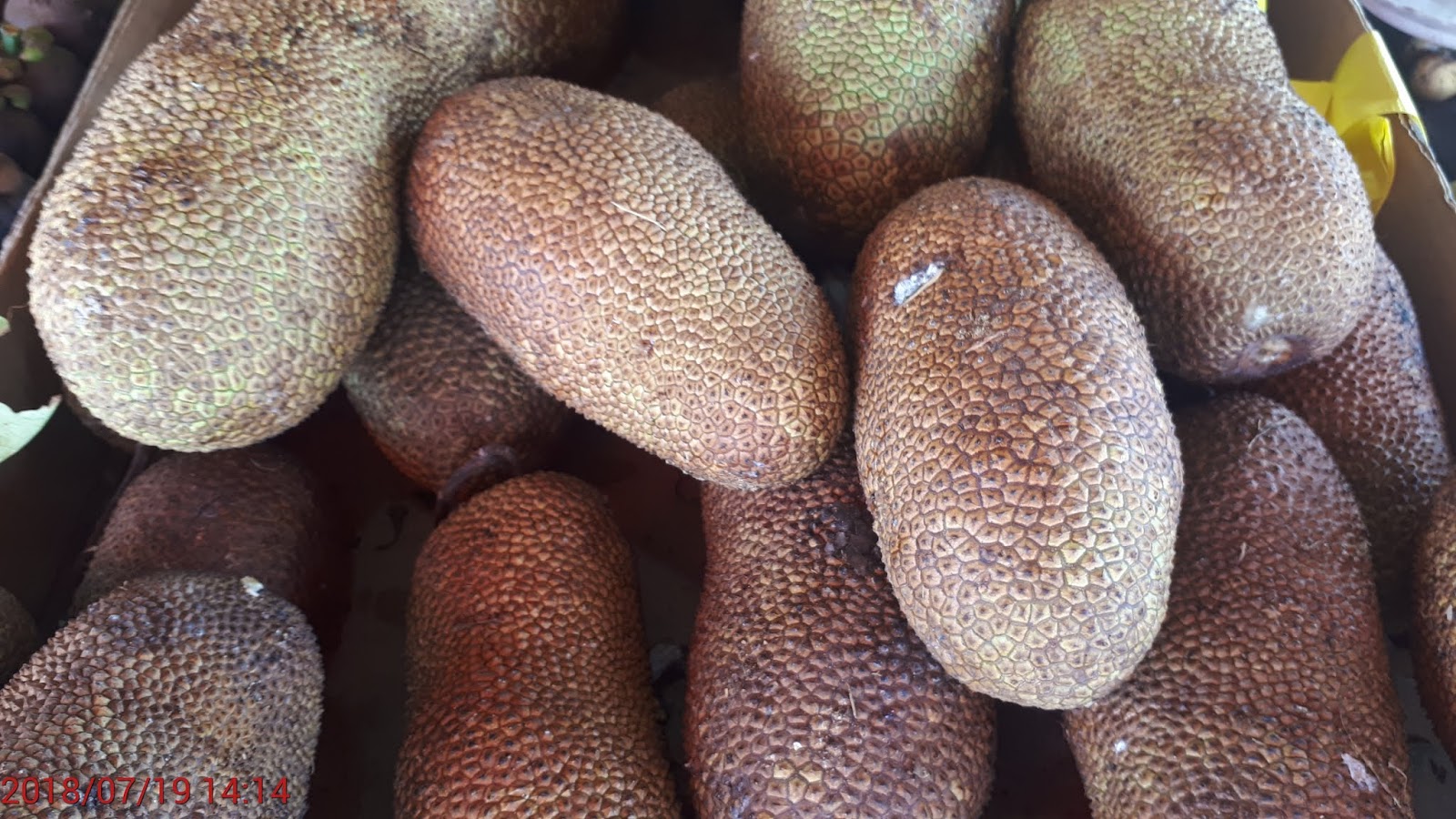
Seremban : Kerdas


Kerdas atau genuak iaitu nama saintifiknya ialah Archidendron bubalinum merupakan sejenis buah dari pokok Kerdas yang sering dijadikan sebagai ulam serta dimakan bersama nasi. Ianya mengeluarkan bau yang agak kuat sama seperti ulam petai atau jering. Pokok Kerdas merupakan sejenis pokok berkayu, saka dan malar hijau.


 Kulit kerdas agak keras dan liat serta mempunyai saiz memanjang dan isi di dalamnya berulas-ulas. Ulas isinya agak kecil di antara (10mm-15mm) dan ianya berkulit nipis sama seperti kulit isi jering. Warna isinya bergantung kepada ketuaan buah ini jika sudah tua atau disimpan lama warnanya akan menjadi kehitaman dan jika isinya masih muda atau baru dipetik ianya bewarna kuning pucat (keputih-putihan). Daun pokok kerdas ini bertekstur nipis dan lembut daun mudanya pula bewarna ungu.


Kerdas dijadikan sebagai ulam bagi menambah selera makan. Baunya agak kuat hingga melekat pada bau nafas selepas memakan ulam ini. Kerdas ini boleh bertahan lama jika disimpan bersama kulitnya. 


sumber : Wikipedia Bahasa Melayu

Sunday, 17 March 2019

Seremban : Rambai


Baccaurea is a genus of flowering plant belonging to the family Phyllanthaceae. The genus comprises over 100 species, distributed from Indomalesia to the West Pacific.
  
Bauccarea motleyana is known as rambai in Malaysia.  It is a medium sized tree, growing up to 9 to 12 meters in height with short trunk and a broad crown. 


The evergreen leaves are shiny green on the upper surface and greenish-brown and hairy underneath.

The flowers are dioecius, with male and female flowers growing on separate trees. 


Fruits are 2 to 5 cm long, with velvety pinkish, yellow, or brown skin, containing  3-5 seeds.  The pulp is sweet to acid in taste.


The specific name motleyana is for James Motley ( 1781-1863 ), who collected the specimen in Borneo prior to his murder.  His name also provides the basic for the generic name Motleyia for several other Malesian plants.


Saturday, 22 September 2018

Jungle Produce @ Seremban


Kerdas atau genuak iaitu nama saintifiknya ialah Archidendron bubalinum merupakan sejenis buah dari pokok Kerdas yang sering dijadikan sebagai ulam serta dimakan bersama nasi. Ianya mengeluarkan bau yang agak kuat sama seperti ulam petai atau jering. Pokok Kerdas merupakan sejenis pokok berkayu, saka dan malar hijau.

Kulit kerdas agak keras dan liat serta mempunyai saiz memanjang dan isi di dalamnya berulas-ulas. Ulas isinya agak kecil di antara (10mm-15mm) dan ianya berkulit nipis sama seperti kulit isi jering. Warna isinya bergantung kepada ketuaan buah ini jika sudah tua atau disimpan lama warnanya akan menjadi kehitaman dan jika isinya masih muda atau baru dipetik ianya bewarna kuning pucat (keputih-putihan). Daun pokok kerdas ini bertekstur nipis dan lembut daun mudanya pula bewarna ungu.

Kerdas dijadikan sebagai ulam bagi menambah selera makan. Baunya agak kuat hingga melekat pada bau nafas selepas memakan ulam ini. Kerdas ini boleh bertahan lama jika disimpan bersama kulitnya. 

sumber : Wikipedia Bahasa Melayu


Buah perah ( Elateriospermum taposmerupakan sejenis buah yang berasal dari pokok perah yang tumbuh di dalam hutan hujan khatulistiwa di Malaysia ini. Buah ini akan gugur sendiri ke bumi apabila ianya sudah cukup tua atau matang.

Buah perah ini berbentuk lonjong dan berwarna hitam. Saiz buahnya agak kecil kira-kira (30mm hingga 40mm). Kulitnya keras, nipis dan licin manakala isinya pejal dan keras berwarna putih. Buah ini pada asalnya di dalam satu kepompong dan mengandungi 3 biji.

Buah perah yang sudah cukup tua atau matang akan gugur ke bumi, ianya akan meletup dan berderai di udara sebelum jatuh ke bumi. Faktor angin memainkan peranan yang cukup penting dalam proses pengguguran buah ini. Selain itu faktor haiwan seperti kera atau monyet juga boleh membantu proses pengguguran buah ini.

Kulitnya sangat keras dan untuk mendapatkan isinya ia perlu diketuk bagi memecahkan kulit tersebut. Isinya jika dimakan secara mentah (tanpa diproses atau dimasak) serta secara berlebihan boleh menyebabkan mabuk atau pening kepala. Isinya bewarna putih dan keras sama seperti buah badam dan ianya boleh dimakan tetapi perlu dimasak atau diproses dengan betul. 

Buah ini boleh juga di buat asam rong makanan tradisional masyarakat di negeri Pahang. Bagi sesetengah penduduk mereka membuat jeruk dengan menggunakan buah perah ini. Selain itu buah ini boleh juga dimasak atau digoreng untuk hidangan sebelah petang.

Bagi masyarakat dahulu mereka suka menjerukkan buah ini dan disimpan hingga berbulan-bulan lamanya tanpa perlu disimpan di dalam peti sejuk. Penyimpanan di dalam tempayan atau balang besar yang diisi dengan air dan sukatan garam yang betul boleh membuatkan buah ini tahan lebih lama. Buah perah juga boleh di jeruk dengan mencampurnya dengan isi petai yang membuatkan aromanya lebih sedap.

sumber : Wikipedia Bahasa Melayu


Friday, 24 November 2017

Pitcher Plant @ Seremban2


Nepenthes gracilis

Synonyms : N. korthalsiana, N. longinodis, N. laevis, N. angustifolia,
Common name : Slender pitcher-plant
Native : Borneo, Indochina, Kalimantan, Malaya, Sulawesi, Sumatra, Thai.
Characteristics : climber, perennial, autotrophic, terrestrial
Habitat : lowland peat swamp forest or disturbed area with poor soils
Description : Flower : dioecious, yellow, raceme, polycarpic.  Fruit : brown, simple, capsule.
Propagation : seeds, cuttings.
Conservation : UCN Red List of Threatened Species - Least Concern (2000)


p.s. special thanks to Patrick Ong @ fb for ID

Sunday, 19 November 2017

Wayside Alien Fabaceae ( Mimosoideae ) @ Seremban2

Leucaena leucocephala ( petai belalang ) has been described as a ‘miracle tree’ for its multiple uses, yet also dubbed as a ‘conflict tree’ as a noxious weed.

Described as the world’s most widely used forage tree legume by FAO, L. leucocephala in an excellent source of high-protein fodder for animal feed and excellent firewood, and efficient in nitrogen fixation.  The young shoots, young pods, and mature seeds are consumed as food for human.  However, it contains mimosine, a toxic amino acid to non-ruminant vertebrates.

Yet, it is listed as one of the 100 worst invasive alien species by IUCN Invasive Species Specialist Group.  It can grow wide range of soil and rainfall environment, grows quickly and forms dense thickets and produces large quantity of seeds.

Key words : allelopathic, N-fixation, mimosine. 


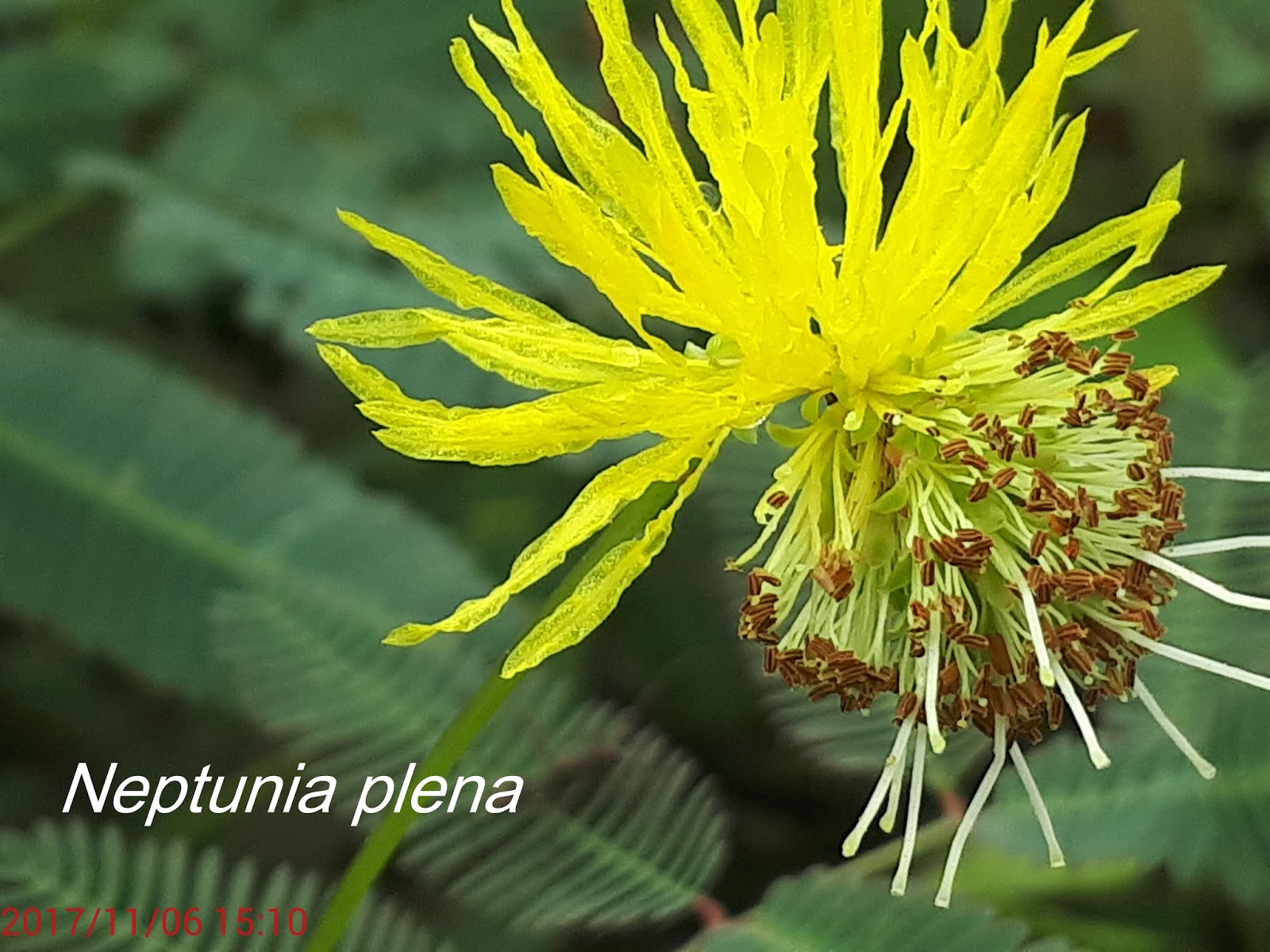
Neptunia plena ( aquatic sensitive plant ) is an invasive plant thriving on waterlogged area and watercourses.  It is not confined to wetlands but tolerates considerable flooding.  During dry period, the plants become dormant and persist as seeds.  It can lead to increased algal blooms reduce water quality by preventing light penetration and reduce oxygenation of water. 

N. plena and N. oleracea are both referred as ‘water mimosa’.  Water mimosa is a restricted invasive plant under Queensland’s Biosecurity Act 2014.

Key words : allelopathic, N-fixation, mimosine. thigmonasty


Mimosa pudica ( sensitive plant )  is most probably the well-known for its rapid plant movement.  It is most often grown as potted plants for its curiosity value.  It also became an ideal plant for experiments regarding plant habituation and memory.

M. pudica has been listed in the Global Invasive Species Databease 2010.

Key words : allelopathic, N-fixation, nyctinastic, mimosine. thigmonasty


Mimosa diplotricha ( giant sensitive plant ) includes 3 varieties : diplotricha, odibilis and inermis

Although M. diplotricha is an excellent ground cover and green manure, it is restricted invasive plant under Queensland’s Biosecurity Act 2014.

Key words : allelopathic, heliophytic, N-fixation, nyctinastic, mimosine. thigmonasty