Showing posts with label journal. Show all posts

Wednesday, 25 October 2023

Citrus is Complicated 2.0 Genotypes Classification

Thursday, 29 December 2022

Friday, 2 July 2021

The Distribution of the ferns Gleicheniaceae in Peninsular Malaysia

Thorough investigations on morphology, anatomy, spore morphology has revealed that the fern family Gleicheniaceae in Peninsular Malaysia were represented by 4 genera with 14 species and 10 varieties, of which genus  
Dicranopteris (4 species, 7 varieties), 
Diplopterygium (5 species), 
Gleichenia (3 species) and 
Sticherus (3 species, 3 varieties).


Sunday, 21 June 2020

Acacia sensu lato in East and Southeast Asia

Recent research shows that the formerly broadly circumscribed, genus Acacia is polyphyletic and should be treated as comprising at least 5 genera, namely, Acacia sensu stricto, Acaciella, Mariosousa, Senegalia and Vachellia.


The indigenous Acacia sensu lato in East and Southeast Asia comprise 52 species:

32 species of Senegalia, 12 species of Acacia sensu stricto and 8 species of Vachellia.   


Of all, only 8 species are endemic to Malaysia :  

Senegalia borneensis, 

S. donnaiensis, 

S. megaladena var. indochinensis, 

S. pennata subsp. kerrii, 

S. pluricapitata, 

S. pseudointsia, 

S. rugata, and 

Vachellia leucophloea.


Classification schemes for Acacia sensu lato showing species numbers and major areas of occurrence. 

https://www.nparks.gov.sg/sbg/research/publications/gardens-bulletin-singapore/-/media/sbg/gardens-bulletin/gbs_67_01_y2015_v67_01/4-4-67-1-231-y2015-v67p1-gbs-pg231.pdf


Simplified, computer-generated cladogram of Acacia sensu lato showing five major monophyletic lineages in red.   https://www2.palomar.edu/users/warmstrong/CaFlora1.htm


Friday, 28 February 2020

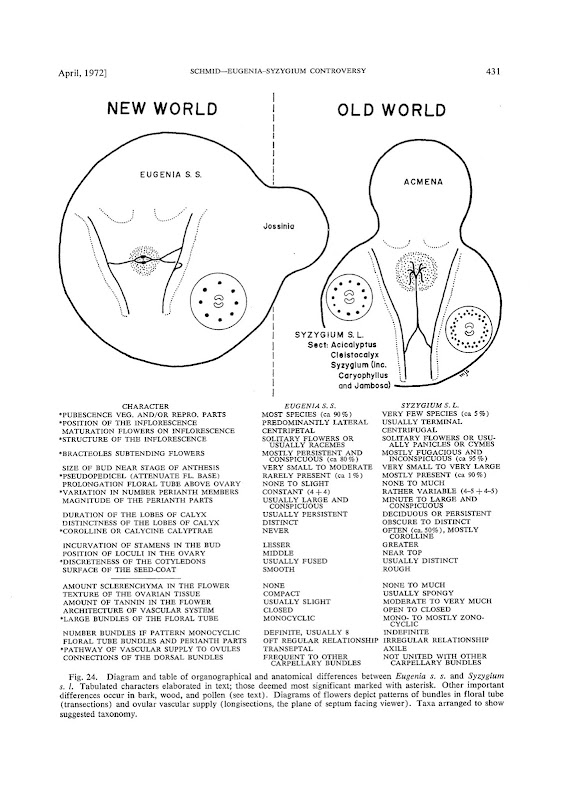
A Resolution of the Eugenia-Syzygium Controversy


ABSTRACT
Floral anatomy now provides additional, strong evidence confirming the distinctness of the mainly New World Eugenia s. s. and the strictly Old World Syzygium s. I. Most significantly, species of Eugenia s. s. have a transeptal vascular supply to the ovules whereas those of Syzygium s. I. have an axile one. Other features of floral histology and vasculature also support such a division. In addition, a review of the taxonomic literature revealed three hitherto neglected organographic criteria-nature of bracteoles, presence or absence of pubescence, and presence or absence of pseudopedicels-that sharply distinguish between Eugenia s. s. and Syzygium s. I. An ensemble of these and other organographic criteria further demonstrates the basic disparity of these taxa. The organography and histology of flowers of Eugenia s. I. are described in detail, with .26 characters contrasting the Old and New World species included in a table.


RUDOLF SCHMID, 1972, Amer. 1. Bot. 59(4): 423-436. 1972., Amer. 1. Bot. 59(4): 423-436. 1972.


Saturday, 19 October 2019

The Four Tribes of Malvoideae

Subfamily Malvoideae now comprises the traditional Malvaceae and has consistently emerged as a very homogeneous, monophyletic group. In a recent treatment of Malvoideae, Bayer and Kutbitzki (2003) divide the subfamily into four tribes: Gossypieae, Hibisceae, Kydieae, and Malveae.

The Malvoideae can be further ranked into the tribes listed below:


Tribe Gossypieae

Tribe Gossypieae has been redifined to include eight genera: Gossypium, Cephalohibiscus, Cienfuegosia, Hampea, Kokia, Gossypioides, Lebronnecia and Thespesia. It is specifically separated from the Hibisceae tribe based on embryo structure and the presence of pigment glands. These glands are associated with the capacity to synthesize the pigment gossypol. The Gossypieae appear to be unique in possessing these glands and this capacity.

More than 50 species of Gossypium are distributed in arid to semi-arid regions of the tropics and subtropics. Of these, four species were independently domesticated for their fiber (cotton) in Africa, Asia and the Americas. Gossypium species exhibit extraordinary morphological variation, with a diverse array of characteristics, ranging from trailing herbaceous perennials to 15m tall trees.


Tribe Hibisceae
Tribe Hibisceae is best known for its largest genus, Hibiscus — one of the world's most popular horticultural plant genera — which includes more than 300 species worldwide. The tribe Hibisceae includes (but is not limited to) :  Abelmoschus, Hibiscadelphus, Hibiscus, Kosteletzkya, Malvaviscus, Pavonia, Radyera, Talipariti and Wercklea.


Tribe Kydieae
0 references

Tribe Malveae


Tribe Malveae includes approximately 70 genera (1000 species) that encompass the majority of the morphological and taxonomic diversity in the Malvoideae subfamily. The genera of Malveae exhibit a broad geographic distribution, with representatives in both tropic and temperate areas in a variety of habitats. Around 15 of the 70 Malveae genera have mostly temperate distributions, while some of the largest genera in the tribe (Abutilon, Sida, Nototriche) have primarily tropical distributions.


The Nine Subfamilies of Malvaceae

The Malvaceae family presents many challenges for taxonomists. Opinions often differ as where to draw the lines between species, between genera, between tribes and between the subfamilies. This is not surprising — the Malvaceae family encompasses over 200 genera with close to 2,300 species!

In terms of number of species, the largest genera include Hibiscus (~300 species), Sterculia (~250 species), Dombeya (~225 species), Pavonia (~200 species) and Sida (~200 species).

In recent years an expanded circumscription of the Malvaceae family has been created, which is composed of nine subfamilies. The relationships between these subfamilies are still obscure, and the subject of ongoing discussion. The traditional Malvaceae have been moved to Malvoideae, the subfamily that now approximately corresponds to that group.


1. Bombacoideae (formerly Bombacaceae, in part), 12 genera, (~120 species).
2. Brownlowioideae,  8 genera, (~70 species).
3. Byttnerioideae, 26 genera, (~650 species).
4. Dombeyoideae, ~20 genera, (~380 species).
5. Grewioideae, 25 genera, (~770 species).
6. Helicteroideae, 8 to 12 genera, 10 to 90 species.
7. Sterculioideae, (formerly Sterculiaceae, in part), 12 genera, (~430 species).
8. Tilioideae, (formerly Tiliaceae, in part) 3 genera, (~50 species).
9. Malvoideae, (formerly Malvaceae), 78 genera, (~1,600 species).